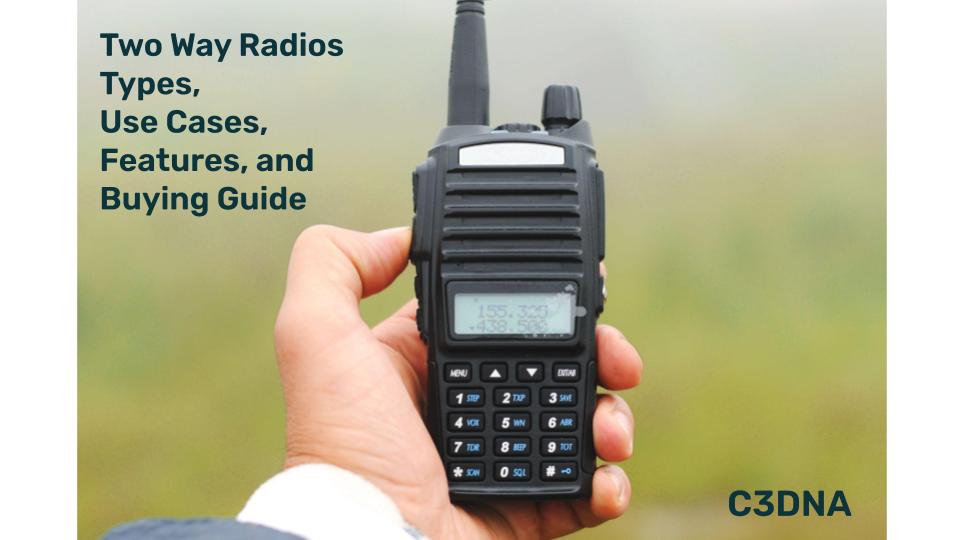
Two-way radios remain one of the most reliable communication tools available today. Whether you’re coordinating an event, staying connected outdoors, managing job-site operations, or preparing for emergencies, a radio offers instant, clear, and dependable communication without relying on cellular networks.
A versatile consumer radio set for camping, hiking, family activities and general outdoor communication.
Check Midland PriceA rugged floating radio designed for rain, boating, paddling and other wet outdoor conditions.
Check Motorola PriceA compact commercial radio for retail, hospitality, offices, schools and other workplace environments.
Check CLS1410 PriceAn affordable programmable handheld for licensed amateur-radio users who want extensive accessory and software support.
Check BaoFeng PriceA premium handheld combining two-way communication, GPS navigation and location-sharing features.
Check Garmin PriceA lower-cost rechargeable radio pair for casual camping, family trips and occasional outdoor use.
Check Cobra PriceCheck current pricing, licensing requirements and package contents before purchasing.
This guide breaks down the main types of two-way radios, their ideal use cases, the features that matter most, and what to look for before making a purchase.
Types of Two-Way Radios
FRS Radios
Family Radio Service (FRS) radios are simple, license-free handhelds designed for short-range communication. They operate on preset UHF channels and have fixed antennas. Popular for family activities, parks, camping, and light use.
Best for: casual use, short-distance communication, kids, day trips.
GMRS Radios
General Mobile Radio Service (GMRS) radios offer more power, removable antennas, and better range than FRS. A GMRS license is required in many regions, but no test is needed. Ideal for outdoor adventures, off-roading, and emergency preparedness.
Best for: off-road groups, family communication, outdoor crews, preppers.
- Designed for outdoor and recreational GMRS use
- Suitable for farms, hunting, off-road trips and large properties
- Supports more advanced operation than basic FRS radios
- Check local licensing requirements before transmitting
Amateur (Ham) Radios
Ham radios offer the widest range, greatest flexibility, and access to thousands of repeaters. They require a license and provide features like wideband receive, cross-band repeat, high power levels, and advanced settings.
Best for: hobbyists, emergency communication, long-distance operation, volunteers.
Commercial / Business Radios
These radios operate on licensed business frequencies and feature rugged construction, long battery life, and reliable performance in noisy or demanding environments. Common in warehouses, construction sites, and event management.
Best for: professional use, manufacturing, hotels, security teams, retail.
Marine Radios
Designed for boating and coastal use, marine VHF radios offer weather alerts, emergency channels, and excellent offshore range. Required or recommended on many vessels.
Best for: boating, fishing, marine navigation.
Aviation Radios
Built for pilots and aviation crews, these radios operate on AM airband frequencies and provide reliable aircraft-to-aircraft and aircraft-to-tower communication.
Best for: pilots, flight schools, aviation hobbyists.
Digital Radios (DMR, P25, NXDN)
Digital radios provide clearer audio, enhanced privacy, better battery life, and advanced networking options. Widely used in public safety, corporate security, and large facilities.
Best for: mission-critical work, large organizations, professional security, emergency services.
Comparison Table: Two-Way Radio Types
| Radio Type | License Required? | Typical Range | Power Level | Best For | Key Advantages |
|---|---|---|---|---|---|
| FRS | No | 0.5–2 miles | Fixed low power | Families, casual users | Simple, inexpensive, license-free |
| GMRS | Yes (no exam) | 1–5 miles handheld, more with repeaters | Up to ~5 W handheld | Off-road, outdoor groups, preppers | Better range, removable antennas, repeater support |
| Ham (Amateur) | Yes (exam required) | 1–20+ miles, unlimited with repeaters | Up to 5–50 W | Hobbyists, emergency comms | Maximum flexibility, huge repeater network |
| Commercial / Business | Yes (business license) | 1–10 miles | 2–5 W | Job sites, warehouses, hotels | Rugged, durable, long battery life |
| Marine VHF | No (required on many vessels) | 5–20 miles | 1–25 W | Boating, marine navigation | Long range, emergency channels, weather alerts |
| Aviation | No (pilot license applies) | Varies, often long range | AM airband | Pilots and flight ops | High reliability, aircraft safety comms |
| Digital (DMR, P25, NXDN) | Yes (varies) | 1–10 miles | 2–5 W | Public safety, corporate security | Clear audio, privacy, group calling |
Key Use Cases for Two-Way Radios
Outdoor Adventures
Hikers, campers, hunters, and off-roaders depend on radios when cell coverage is unreliable. GMRS and ham radios excel here due to their long-range capability and durability.
Emergency Preparedness
In power outages or disasters, radios remain dependable. Families often choose FRS or GMRS, while trained volunteers prefer ham radios for maximum flexibility.
Construction and Job Sites
Rugged commercial radios help teams coordinate safely. Their loud audio and long battery life make them ideal for noisy, intensive environments.
Events and Security
Concerts, conventions, and festivals rely on immediate communication. Digital radios provide clear audio even in congested RF spaces.
Hospitality and Retail
Hotels, restaurants, and retail stores use business radios to improve coordination and customer service.
Boating and Maritime
Marine radios provide weather alerts and emergency channels, making them essential for safe navigation.
Clips near the shoulder so the radio can remain secured to a belt, vest or backpack.
View Speaker MicrophonesUseful for security, hospitality, retail and other environments where discreet communication is preferred.
View Radio EarpiecesExtends operating time during long shifts, camping trips and emergency use.
View Spare BatteriesUseful for compatible programmable radios that support computer-based channel and settings management.
View Programming CablesKeeps several staff radios organised and charged from one central station.
View Multi-Unit ChargersAdds protection and makes the radio easier to carry on belts, packs and work gear.
View Radio CasesWhat to Look For in a Two-Way Radio
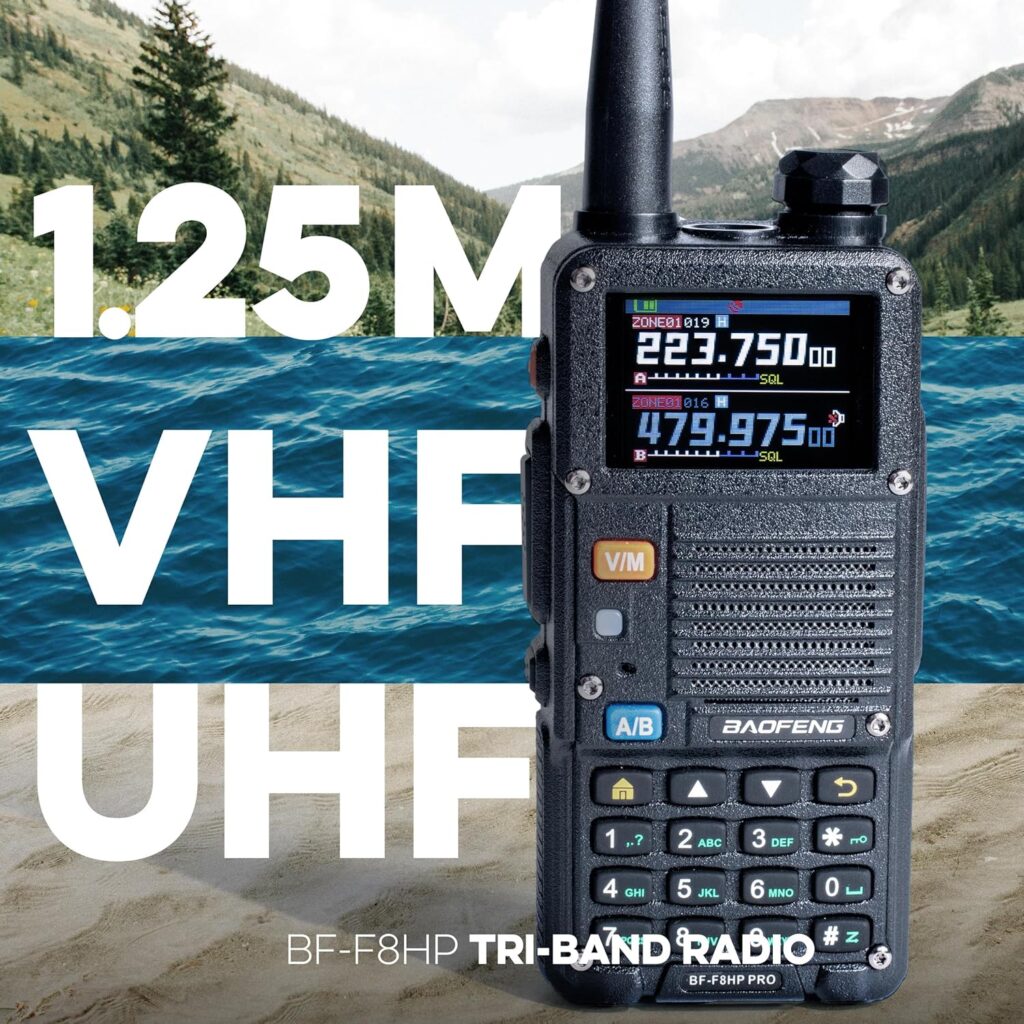
Frequency Band: VHF vs UHF
VHF performs best outdoors with fewer obstructions.
UHF penetrates buildings better and is ideal indoors or in urban settings.
Range and Power Output
More wattage does not always mean more range. Terrain matters more. FRS radios offer short-range communication, while GMRS, ham, and commercial radios can reach long distances with repeaters.
Durability and Build Quality
Look for features like reinforced casings, waterproofing, and shock resistance if you’ll be outdoors or on job sites.
Audio Quality
Louder speakers and noise-reduction tech improve clarity, especially in busy environments.
Battery Life
High-capacity Li-ion packs offer 12–24 hours of mixed use. Swappable batteries add flexibility.
Antenna Options
Removable antennas allow range upgrades. FRS radios with fixed antennas are more limited.
Emergency Features
Useful features include SOS alarms, NOAA weather channels, flashlights, and IP-rated waterproof designs.
Programming and Software
Ham, GMRS, and business radios often require computer-based programming. CHIRP-enabled models make setup easier.
Analog vs Digital
Analog is simple and affordable.
Digital radios provide clearer audio, better privacy, longer battery life, and more advanced functions.
Choose a consumer radio for family and recreational use, a commercial radio for workplace reliability, or a programmable amateur radio only when you understand the applicable licensing and operating rules.
Midland GXT1000VP4 for camping, family use and general outdoor communication.
View Midland RadioMotorola CLS1410 for staff communication in retail, hospitality and offices.
View Motorola RadioBaoFeng UV-5R for licensed users who need a programmable dual-band handheld.
View BaoFeng RadioWhen to Choose Which Radio
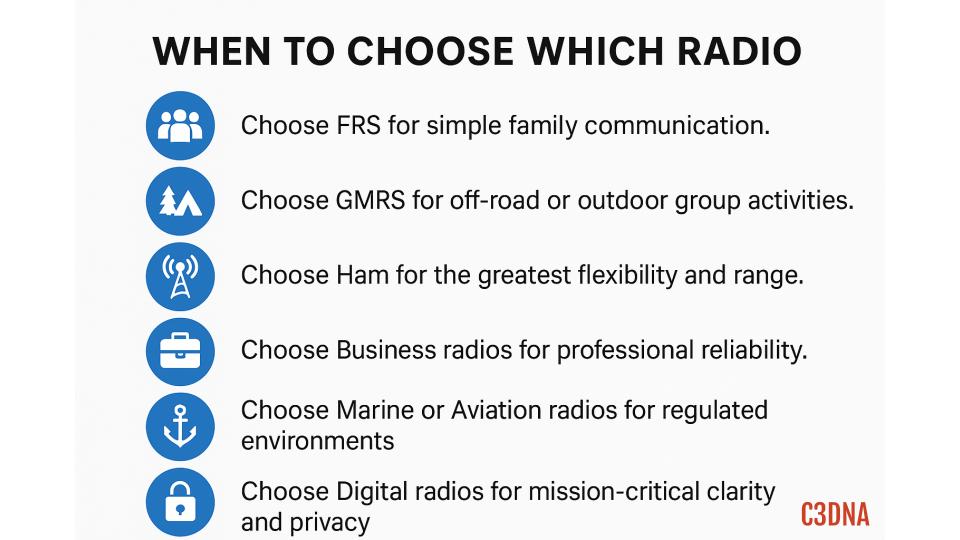
Choose FRS for simple family communication.
Choose GMRS for off-road or outdoor group activities.
Choose Ham for the greatest flexibility and range.
Choose Business radios for professional reliability.
Choose Marine or Aviation radios for regulated environments.
Choose Digital radios for mission-critical clarity and privacy.
Tips Before Buying
Determine the environment where the radio will be used.
Check whether licensing is required.
Look for accessory availability such as antennas and batteries.
Decide how rugged the radio needs to be.
Consider whether you need repeater access.
If buying for a group, standardize on one model for ease of use.
Conclusion
Two-way radios remain essential tools across outdoor adventures, emergencies, professional operations, and day-to-day communication. The right radio depends on your range requirements, environment, and the level of ruggedness or features you need. With the appropriate model, you gain reliable communication that works anywhere, even when cell networks fail.
Frequently Asked Questions About Two-Way Radios
What is a two-way radio?
A two-way radio is a communication device that can both transmit and receive audio signals, allowing people to talk back and forth instantly without relying on cellular networks.
How far can two-way radios communicate?
Range depends heavily on terrain, obstacles, antenna quality, and power output. FRS radios may reach 0.5–2 miles, GMRS can reach several miles, and ham radios can reach dozens of miles or more with repeaters.
What is the difference between VHF and UHF radios?
VHF works best outdoors with fewer obstructions, while UHF performs better in buildings, forests, and urban environments. The choice depends on where you’ll use the radio most.
Do I need a license to use a two-way radio?
It depends on the type. FRS radios do not require a license. GMRS requires a license in many countries, while ham radios require passing a test. Commercial radios also require specific business licensing.
What is the difference between FRS, GMRS, and Ham radios?
FRS is simple, license-free, and low power. GMRS supports higher power and repeaters but requires a license. Ham radios offer the most versatility, wide frequency ranges, and long-distance communication but require an exam.
Can two-way radios work without cell service?
Yes. Radios communicate directly using radio waves and are completely independent of cellular towers or the internet. This makes them reliable during emergencies or in remote areas.
Can different brands of radios communicate with each other?
Yes, as long as they operate on the same frequency and use the same tone settings. However, some commercial or digital systems are proprietary and require matching equipment.
What affects the range of a two-way radio?
Obstacles such as buildings, hills, and trees reduce range. High power, tall antennas, and repeater support extend it. Weather and radio interference can also influence performance.
What is a repeater and why is it useful?
A repeater listens on one frequency and rebroadcasts the signal on another, dramatically increasing communication range. GMRS and ham operators frequently use repeaters to link long distances.
Are digital radios better than analog radios?
Digital radios offer clearer audio, longer battery life, better privacy features, and improved performance in noisy environments. Analog radios are simpler and often cheaper.
What features should I look for in a two-way radio?
Important features include battery life, audio quality, durability, removable antennas, weather alerts, repeater capability, IP ratings, programming software, and accessory availability.
How long does the battery typically last?
Most handheld radios provide 8–20 hours of mixed use depending on the battery size and power settings. High-capacity batteries can significantly extend runtime.
What is dual PTT or dual watch?
Dual PTT allows quick transmission on two channels using separate buttons. Dual watch monitors two channels simultaneously. These features are helpful for teams coordinating across multiple groups.
Are two-way radios waterproof?
Some are, but not all. Look for IP ratings. For example, IP54 means splash resistance, while IP67 means waterproof and dustproof for rugged outdoor use.
Can I use a two-way radio internationally?
It depends on local regulations. Many countries use different frequency rules. Always check the legal requirements of the region before transmitting.
What accessories improve performance?
High-gain antennas, extended batteries, earpiece headsets, speaker mics, and carrying cases are common upgrades. Antenna changes often provide the biggest improvement in range.