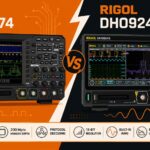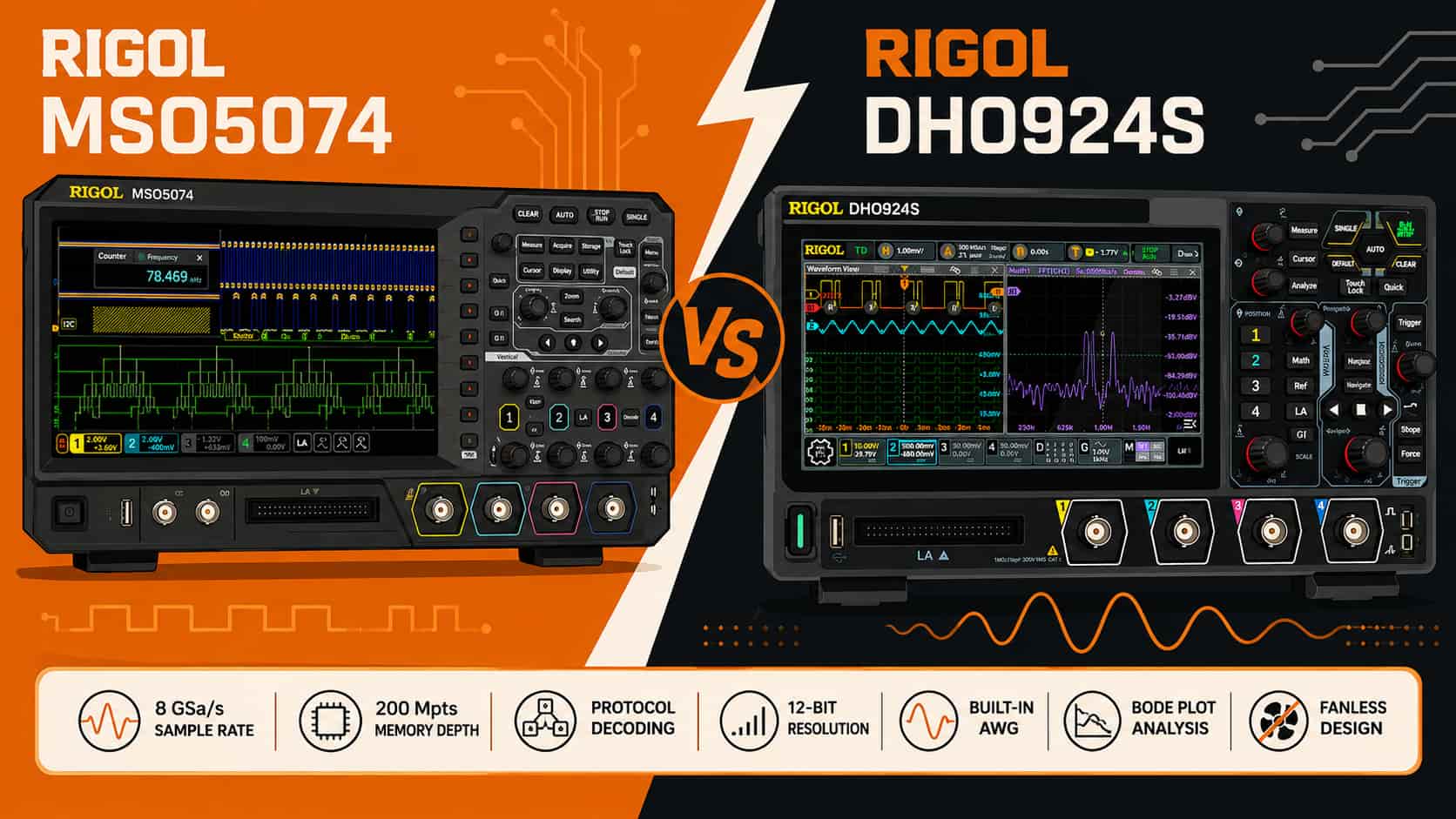
Rigol has priced these two oscilloscopes within a few hundred dollars of each other, which makes the comparison inevitable. Both are 4-channel mixed-signal scopes with touchscreens, deep feature sets, and respectable specifications for the money. But they are built around different engineering priorities, and buying the wrong one for your workflow is a real risk.
Here is what actually matters for RF and electronics engineers.
The Fundamental Trade-off: Resolution vs Sample Rate
The DHO924S uses a 12-bit ADC. The MSO5074 uses an 8-bit ADC. That is the difference between 256 vertical quantisation levels and 4,096 — a 16x improvement in vertical resolution.
Best for Mixed-Signal Debugging: Rigol MSO5074
Choose the MSO5074 if you need deep memory, protocol decoding, a larger display, high sample rate, and a strong upgrade path for embedded and mixed-signal work.
Check MSO5074 Price on Amazon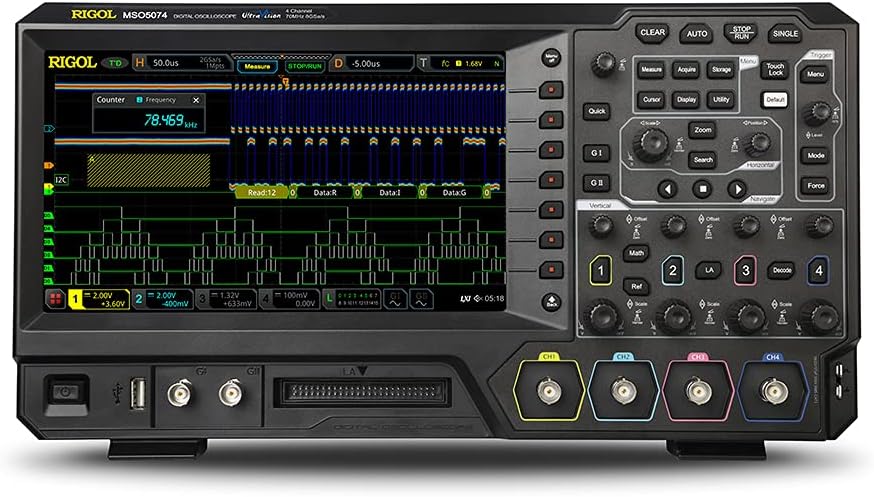
For RF work, power integrity, and small-signal analog measurements, this matters considerably. The DHO924S’s 200 µV/div sensitivity and ultra-low noise floor let you resolve power supply ripple, LNA noise characterisation, and weak sensor outputs with a clarity that an 8-bit front end simply cannot match. If you have spent time on a standard scope trying to distinguish 5 mV of ripple from quantisation noise, you will understand immediately why this is significant.
Best for RF, Analog & Power Integrity: Rigol DHO924S
Choose the DHO924S if you care most about 12-bit resolution, low-noise measurements, fine vertical sensitivity, built-in AWG, Bode plot analysis, and fanless operation.
Check DHO924S Price on Amazon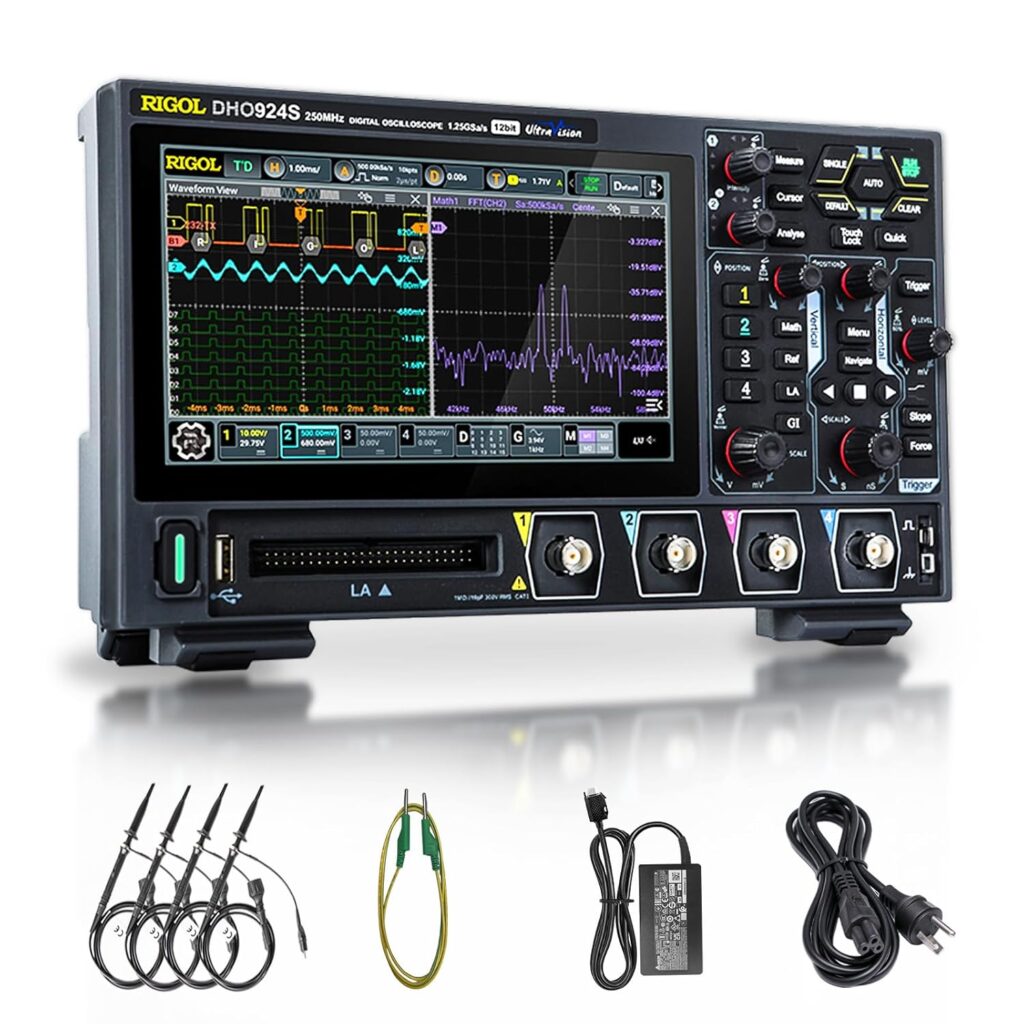
The cost of 12-bit resolution is sample rate. The MSO5074 reaches 8 GSa/s. The DHO924S tops out at 1.25 GSa/s. For most RF bench work below 100 MHz this is not a practical constraint. For characterising fast digital edges or sub-nanosecond transients it is.
Bandwidth and Upgrade Path
The DHO924S ships with 250 MHz bandwidth. The MSO5074 starts at 70 MHz but supports software licence upgrades to 100, 200, or 350 MHz. The DHO924S bandwidth is fixed — there is no upgrade path beyond 250 MHz.
Applying the 1:5 rule: the DHO924S accurately measures signals to around 50 MHz at its base configuration, while the unlocked MSO5074 at 350 MHz extends that to roughly 70 MHz. For engineers working in the VHF and lower UHF range, the DHO924S’s native bandwidth is the more honest specification. For those who need to grow into faster work over time, the MSO5074’s upgrade path has practical value.
Specification Comparison
| Feature | MSO5074 | DHO924S |
|---|---|---|
| ADC resolution | 8-bit (256 levels) | 12-bit (4,096 levels) |
| Base bandwidth | 70 MHz | 250 MHz |
| Max bandwidth (upgraded) | 350 MHz | 250 MHz (fixed) |
| Max sample rate | 8 GSa/s | 1.25 GSa/s |
| Memory depth | 200 Mpts | 50 Mpts |
| Vertical sensitivity | 1 mV/div | 200 µV/div |
| Built-in AWG | Optional add-on | 25 MHz, standard |
| Bode plot analysis | No | Yes, standard |
| Display | 9″ capacitive touch | 7″ capacitive touch |
| Fan cooling | Yes | Fanless |
Integrated Tools
The DHO924S includes a 25 MHz single-channel AWG and Bode plot analysis as standard. For power supply loop stability work, amplifier characterisation, or filter verification, having Bode plot capability without a separate signal source is genuinely useful at this price point. The MSO5074 requires an optional licence for AWG and does not include Bode plot natively.
The MSO5074 counters with deeper integration across digital domains — protocol decoding for I²C, SPI, UART, CAN, and LIN, a spectrum analyser mode, and 200 Mpts of memory versus the DHO924S’s 50 Mpts. For long digital captures and multi-layer mixed-signal debugging the MSO5074’s memory depth advantage is tangible.
What Engineers in the Field Say
The EEVblog and Fedevel communities have covered this comparison in detail. The pattern in experienced user feedback is consistent.
One engineer on the Fedevel forum summarised the MSO5074 position clearly: the scope “can be improved to some degree beyond the DHO924S” through upgrades, but “it is 8-bit and will remain 8-bit.” The same contributor noted the MSO5074’s cooling fan as a practical irritant that the DHO924S avoids entirely.
Rigol DHO924S
For RF front-end work, power integrity analysis, and low-noise analog measurements, the DHO924S is the stronger instrument. The jump from 8-bit to 12-bit resolution is immediately visible on weak or noisy signals.
View DHO924S on AmazonEngineers moving from 8-bit scopes to the DHO924S consistently report that the visibility improvement on analog signals is immediate and not subtle — particularly on power rail measurements and low-amplitude RF signals where quantisation artefacts on an 8-bit scope are easy to mistake for real signal content.
On the MSO5074 side, the deep memory and protocol suite draw consistent praise from firmware engineers and anyone doing simultaneous multi-domain debugging where the larger display and longer capture windows matter.
Rigol MSO5074
The MSO5074 excels in firmware, protocol decoding, and deep multi-domain captures. If your workflow involves SPI, UART, CAN, or long digital traces, the larger memory depth is a major advantage.
View MSO5074 on AmazonThe Decision
MSO5074 is the stronger choice for mixed-signal and embedded work: deep memory, broad protocol support, large display, and a software upgrade path. Its 8-bit ADC is the ceiling you live with.
DHO924S is the stronger choice for analog, RF front-end, and power integrity work: 12-bit resolution, lower noise floor, native 250 MHz bandwidth, built-in AWG and Bode plot, fanless operation, and a more portable form factor.
Final Verdict
If you primarily work on RF front ends, analog circuits, power electronics, or low-level signal analysis, the DHO924S is the more compelling instrument.
If your workflow revolves around embedded debugging, protocol decoding, and long mixed-signal captures, the MSO5074 remains a powerhouse.
Both instruments represent genuinely different tools for different engineers. The MSO5074 gives you breadth. The DHO924S gives you depth. At similar price points, the right answer depends entirely on which limitation you can live with — an 8-bit noise floor or a 1.25 GSa/s sample rate ceiling.
For RF and power electronics work specifically, the DHO924S is the more natural fit.