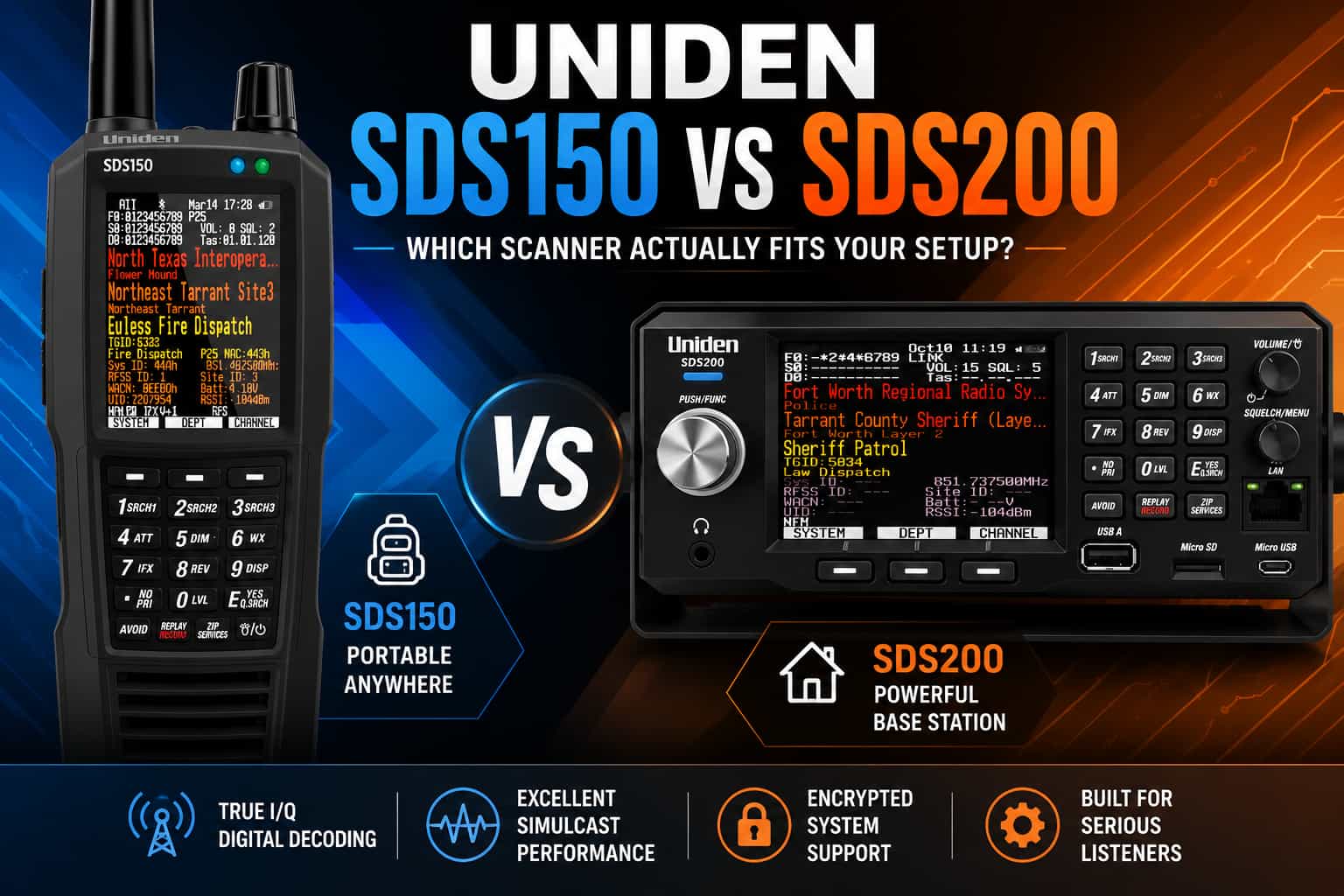
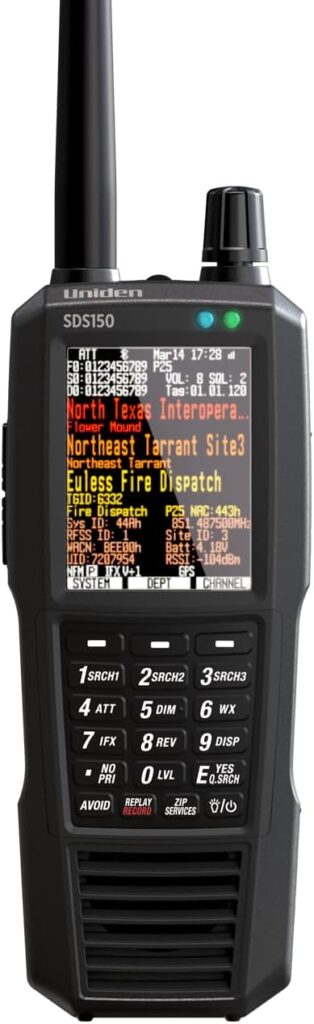
The SDS150 and SDS200 are often compared as if they’re competing for the same buyer, but they’re solving two different problems. The SDS150 is a handheld built for mobility. The SDS200 is a base/mobile unit built for a permanent installation, whether that’s a desk at home or a dashboard in a vehicle. Both share Uniden’s True I/Q decoding platform, but the hardware around that core is built for entirely different use cases. This comparison is less about which scanner is “better” and more about which form factor matches how you actually plan to use it.
📡 Quick Recommendation
If you’re deciding between the Uniden SDS150 and SDS200, both scanners deliver the same excellent SDR-based receiver performance and True I/Q digital decoding. The biggest difference is how and where you’ll use them.
|
🏆 Best Portable Uniden SDS150 Perfect for travel, events, storm spotting and portable monitoring. Check Price |
🏠 Best Base Station Uniden SDS200 Ideal for home, vehicle and permanent monitoring stations. Check Price |
⭐ Best Accessory Diamond RH77CA Antenna A simple upgrade that noticeably improves reception on handheld scanners. Check Price |
Specs at a Glance
| Feature | SDS150 | SDS200 |
|---|---|---|
| Form Factor | Handheld | Base/mobile, 1.5× DIN-E size |
| Receiver Platform | True I/Q SDR | True I/Q SDR |
| Frequency Coverage | 25–512 MHz, 758–824 MHz, 849–869 MHz, 894–960 MHz, 1240–1300 MHz | Same |
| Digital Decoding | P25 Phase I/II, Motorola, EDACS, LTR | P25 Phase I/II, X2-TDMA, Motorola, EDACS, LTR |
| Optional Paid Upgrades | DMR, NXDN, ProVoice | DMR Tier III, Hytera XPT, NXDN, ProVoice, Capacity+/Connect+ |
| GPS | Built-in | External puck required (Uniden GPS accessory) |
| Power | Internal battery, USB-C charging | AC adapter, 12V DC, or vehicle power harness |
| Connectivity | Bluetooth (U/AWARE app) | Direct Ethernet (remote streaming and control), no Wi-Fi |
| Display | Color LCD, 240×320 | 3.5″ customizable color LCD, 147 selectable colors |
| Pre-amplifier | Standard front end | Integrated VHF/UHF pre-amplifier |
| Mounting | Handheld, belt clip | Mounting bracket included, dash or rack mountable |
| Waterfall Display | Included | Included (added via firmware on earlier units) |
| Water Resistance | JIS4/IPX4 | Not rated (indoor/vehicle use) |
What’s Actually the Same
Both scanners run on Uniden’s True I/Q SDR receiver core and TrunkTracker X decoding, which means both deliver the same fundamental advantage over older scanner generations: capturing the complete signal waveform rather than processing it the way conventional scanners do, which dramatically improves performance on simulcast P25 systems that cause older scanners to garble audio. Both share the same frequency coverage, the same core protocol support, and the same optional paid upgrade structure for DMR, NXDN, and ProVoice. Both also include Uniden’s Sentinel software for free firmware and database updates, and both ship with the complete RadioReference USA/Canada database pre-loaded.
🏆 Uniden SDS150
If you attend airshows, public events, travel frequently, or simply prefer listening away from your desk, the SDS150 is the clear winner. It delivers the same outstanding digital decoding as the SDS200 in a compact handheld package.
- ✔ Portable handheld design
- ✔ Excellent simulcast performance
- ✔ True I/Q SDR receiver
- ✔ Rechargeable battery operation
- ✔ Perfect for travel and field monitoring
Where the SDS200 Pulls Ahead
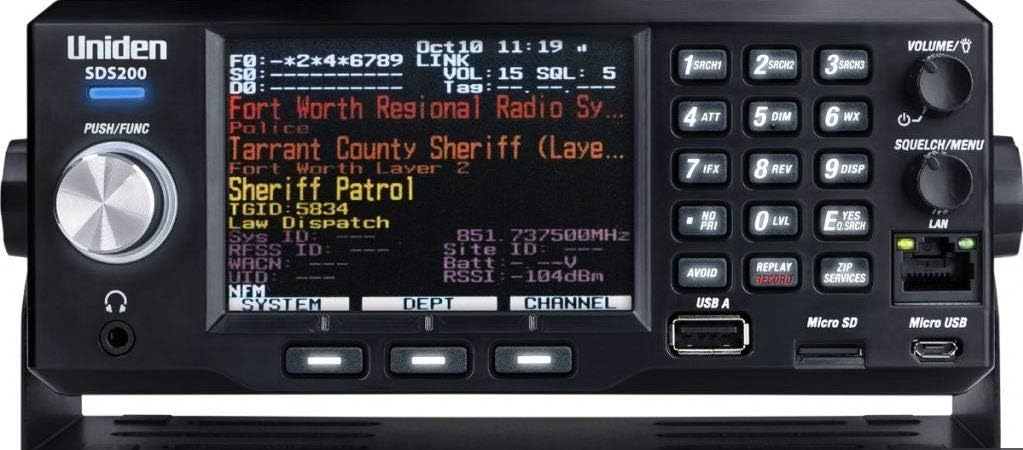
Built for a permanent installation, properly. The SDS200 comes with an AC adapter, a 12V DC adapter, and a dedicated mobile power harness for vehicle installs, plus a mounting bracket sized to fit a dashboard or equipment rack. If you’re setting up a dedicated monitoring station at home or a permanent vehicle install, the SDS200 is built around that use case from the ground up, rather than being a handheld pressed into stationary service.
🏠 Uniden SDS200
The SDS200 is the better choice for home monitoring stations, emergency operations centers and mobile vehicle installations. Its larger display, Ethernet capability and external power design make it ideal for continuous operation.
- ✔ Large color display
- ✔ Ethernet connectivity
- ✔ Continuous 12V operation
- ✔ Excellent for home installations
- ✔ Professional-grade monitoring station
Integrated VHF/UHF pre-amplifier. The SDS200 includes a front-end pre-amp specifically intended to improve digital reception in weak-signal and simulcast-heavy environments. This is hardware the handheld SDS150 doesn’t carry in the same form, and it’s part of why the SDS200 is often the preferred choice for users in genuinely difficult RF environments who plan to use a larger external antenna rather than relying on a stock telescoping whip.
Ethernet connectivity for remote streaming and control. The SDS200 can stream audio and accept remote control commands over a wired network connection, which the SDS150 cannot do natively (its Bluetooth connectivity is built around the U/AWARE phone app, not network-based remote operation). For anyone wanting to monitor a scanner remotely over a home network or stream its audio elsewhere on the network, the SDS200’s Ethernet port is purpose-built for that, while the SDS150’s app simply pairs to a nearby phone.
Larger, more detailed display. The SDS200’s 3.5-inch screen with 147 user-selectable colors is noticeably bigger than the SDS150’s display, which matters more in a fixed installation where you’re glancing at a desk or dash-mounted unit from a distance, rather than holding the unit in your hand.
📶 Improve Reception
Whether you choose the SDS150 or SDS200, upgrading the antenna often produces a bigger improvement than upgrading the scanner itself. A quality aftermarket antenna can significantly increase received signal strength and improve weak-signal performance.
- ✔ Better VHF and UHF reception
- ✔ Stronger public safety signals
- ✔ Easy upgrade
- ✔ Excellent value
Where the SDS150 Pulls Ahead
Built-in GPS. The SDS200 has no built-in GPS receiver at all and requires Uniden’s separate GPS accessory for location-based scanning while mobile. The SDS150 has GPS built directly into the unit. If you want location-aware scanning in a vehicle without adding an external accessory, the SDS150 wins this outright, somewhat ironically, given the SDS200 is the one marketed for vehicle installation.
Portability. This is the entire point of the SDS150’s existence: it runs on an internal battery, charges over USB-C, and fits in a hand or on a belt clip. The SDS200 has no battery option at all and requires continuous power from AC, 12V DC, or a vehicle harness, so it cannot be used away from a power source.
Water resistance. The SDS150 carries a JIS4/IPX4 rating suitable for outdoor and field use. The SDS200 is designed for indoor or in-vehicle use and carries no equivalent water resistance rating, which makes sense given it’s not intended to be carried outdoors.
Bluetooth app control. The SDS150’s U/AWARE app gives you phone-based control and audio routing to Bluetooth earbuds or a car stereo, a feature the SDS200 doesn’t offer in the same form, relying instead on its Ethernet connection for remote access from a fixed network point rather than a mobile phone pairing.
Real Customer Feedback
Feedback on the SDS200 is generally strong on reception performance, with one long-time owner noting it pulls in more locations than any previous scanner they’d used once properly programmed, though the same review flagged a recurring annoyance: department names pulled from the database are frequently inaccurate or display incorrectly. Earlier production units of the SDS200 also drew documented complaints about audio quality, specifically a hum or buzz in the internal speaker and audio that occasionally cut out mid-transmission, issues that retailers report were resolved in a later production revision, so checking which hardware revision you’re buying is worth doing if shopping secondhand.
On the GPS gap specifically, several SDS200 owners installing the unit in vehicles have expressed surprise that a scanner marketed for mobile use doesn’t include GPS standard, given that competing and even Uniden’s own handheld SDS150 includes it. The Ethernet-over-Wi-Fi design choice gets generally positive marks by comparison, with multiple sources noting it’s a deliberate improvement over the Wi-Fi-based remote streaming on the SDS200’s discontinued predecessor, the BCD536HP, which had a reputation for unreliable wireless connectivity.
Recommendation
If you’re setting up a permanent station, home or vehicle, get the SDS200. The integrated pre-amp, proper power options, larger display, and Ethernet-based remote access are all built around staying in one place and performing as well as possible there. Pair it with a real external antenna rather than the stock telescoping whip, since the SDS200’s pre-amp is specifically designed to take advantage of a better antenna.
If you need a scanner that travels with you, get the SDS150. The internal battery, built-in GPS, water resistance, and Bluetooth app control all solve problems that simply don’t exist for a unit that’s bolted to a dashboard or sitting on a desk permanently.
If you genuinely want both, which is a common setup among serious hobbyists, the SDS200 as a fixed home or vehicle base station paired with the SDS150 for field use is a coherent pairing rather than a redundant one, since they’re solving different problems rather than competing for the same job.