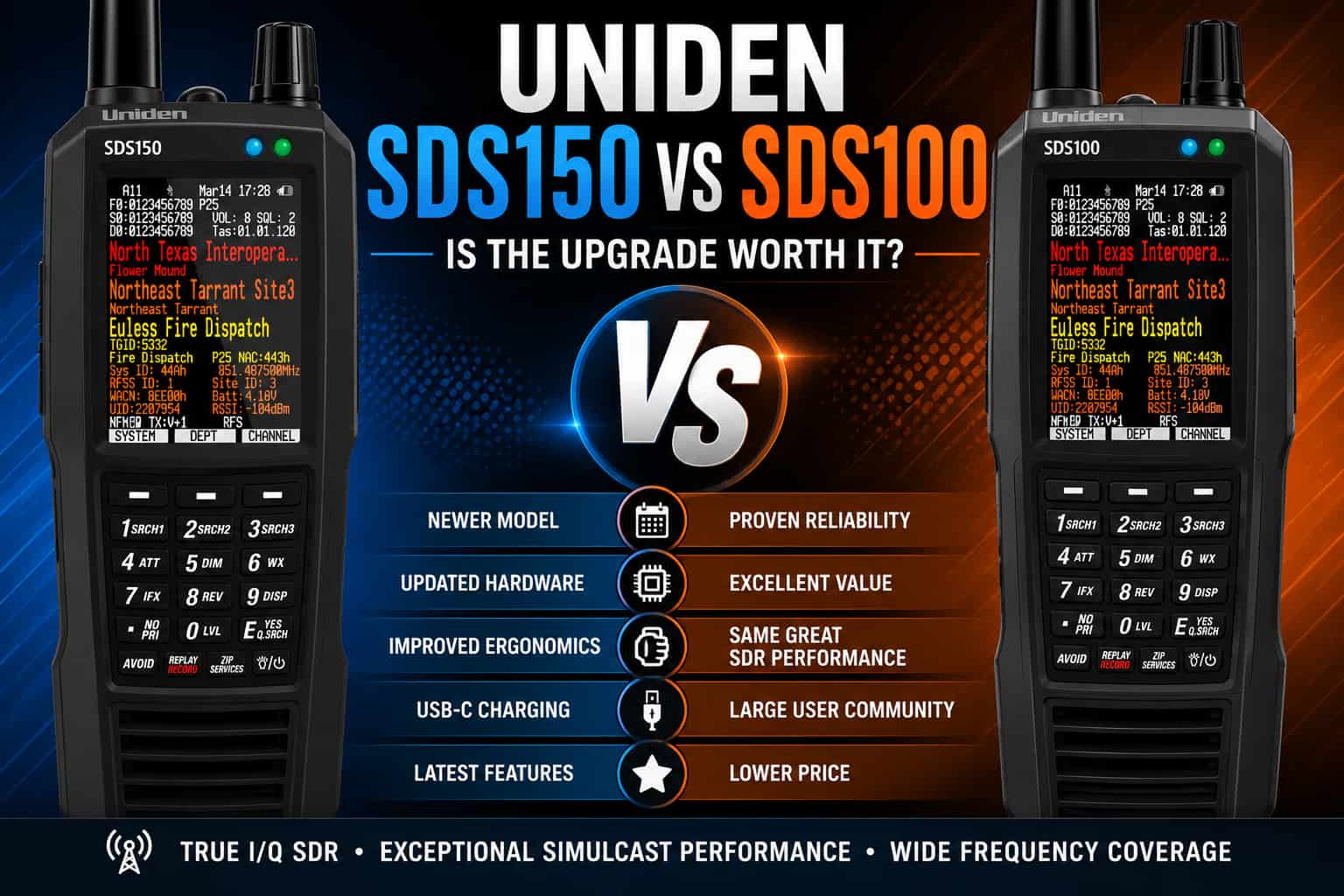
The Uniden SDS100 has been the benchmark handheld scanner for simulcast performance since its 2018 launch. The SDS150, Uniden’s newer flagship, builds on the exact same decoding platform but adds a long list of quality-of-life upgrades. If you’re deciding between the two, the question isn’t whether one decodes digital signals better than the other in a vacuum. It’s whether the SDS150’s extra features and roughly $250 higher price are worth it for how you actually use a scanner.
📡 Quick Recommendation
Both the Uniden SDS150 and SDS100 are excellent handheld scanners with industry-leading SDR technology and outstanding simulcast performance. The SDS150 is the newer model, offering hardware improvements and a refreshed design, while the SDS100 remains an outstanding value with nearly identical scanning capabilities.
|
🏆 Best Overall Uniden SDS150 Newest handheld scanner with updated hardware and improved ergonomics. Check Price |
💰 Best Value Uniden SDS100 Nearly identical receiver performance at a lower price. Check Price |
⭐ Recommended Accessory Diamond RH77CA Antenna A simple antenna upgrade that can noticeably improve handheld scanner reception. Check Price |
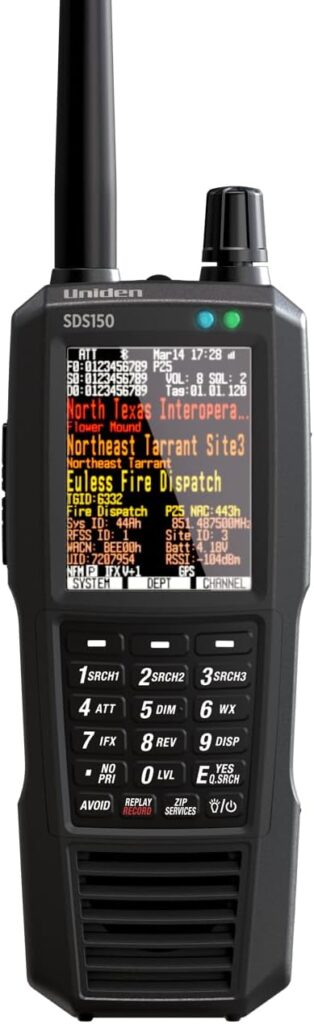
Specs at a Glance
| Feature | SDS100 | SDS150 |
|---|---|---|
| Receiver Platform | True I/Q SDR | True I/Q SDR (refined IF stage) |
| Frequency Coverage | 25–512 MHz, 758–824 MHz, 849–869 MHz, 894–960 MHz, 1240–1300 MHz | Same |
| Digital Decoding | P25 Phase I/II, Motorola, EDACS, LTR | Same |
| Optional Paid Upgrades | DMR, NXDN, ProVoice (~$50–75 each) | Same upgrade keys (not transferable between units) |
| GPS | External puck, sold separately | Built-in receiver |
| Bluetooth / App Control | None | Built-in BLE, U/AWARE app |
| Waterfall Display | Paid upgrade key | Included from factory |
| Display | Color LCD | Larger, brighter color LCD (240×320) |
| Charging | Mini-USB, cradle sold separately | USB-C, charging cradle included |
| Battery | 3-cell lithium polymer pouch | Dual 18650 lithium-ion cells |
| Battery Life | Shorter (user-reported) | ~7–8 hours (user-reported) |
| SD Card Access | Requires removing battery door | Side-accessible |
| Water Resistance | JIS4/IPX4 | JIS4/IPX4 |
What’s Actually the Same
Both scanners share the same True I/Q SDR receiver core, which is the technology that made the SDS100 a standout for decoding P25 simulcast systems that older scanners struggle with. Both decode the same digital protocols out of the box, both support the identical paid upgrade keys for DMR, NXDN, and ProVoice, and both carry the same JIS4/IPX4 water resistance rating. If raw digital decoding capability on paper is your only concern, the SDS150 isn’t a generational leap over the SDS100, it’s a refinement of the same engine.
🏆 Uniden SDS150
If you’re buying a premium handheld scanner today, the SDS150 is the best choice. It builds on the success of the SDS100 with updated hardware, improved controls, and the same excellent SDR architecture that handles difficult simulcast systems exceptionally well.
- ✔ Latest handheld scanner from Uniden
- ✔ Outstanding simulcast reception
- ✔ True I/Q SDR receiver
- ✔ Color display
- ✔ Excellent for public safety, aviation and rail monitoring
Where the SDS150 Pulls Ahead
Built-in GPS is probably the single biggest practical upgrade. The SDS100 supports location-based scanning, but only with an external GPS puck and cable purchased separately. The SDS150 has GPS built in, which means location-aware scanning works the moment you turn it on, with no accessory to forget at home or cable to manage. This matters most for users who scan while traveling, commuting across jurisdictions, or storm chasing.
Waterfall display included from the factory is the second major difference. Waterfall lets you visually see RF activity across a frequency range, which makes finding unknown or active frequencies dramatically faster than scanning blind. On the SDS100, this requires a separate paid upgrade key; on the SDS150 it ships unlocked.
💰 Uniden SDS100
The SDS100 continues to be one of the best handheld digital scanners ever produced. If you can find it at a meaningful discount, it delivers virtually the same scanning performance as the SDS150 and remains an outstanding value.
- ✔ Excellent SDR receiver
- ✔ Superb simulcast decoding
- ✔ Proven reliability
- ✔ Large user community
- ✔ Great value for serious scanner enthusiasts
Bluetooth and app control via U/AWARE gives the SDS150 functionality the SDS100 simply doesn’t have. You can control the scanner and route its audio through your phone to Bluetooth earbuds or a car stereo, which is a meaningfully different experience from being tied to the scanner’s built-in speaker and physical controls.
Charging and battery design favor the SDS150 on paper and in practice. It charges over USB-C, includes a drop-in charging cradle with a slot for an extra battery, and uses dual 18650 lithium-ion cells that user reports describe as more durable than the SDS100’s lithium polymer pouch cells, which have a documented history of premature failure reports from owners. Battery life is also reported as longer on the SDS150, in the 7 to 8 hour range.
RF and IF refinements are a more subtle but real improvement. The SDS150 adds a narrow filter to the IF stage specifically to reduce the need for manual filter adjustments in heavy-interference areas, and several long-time SDS100 owners on RadioReference forums report the SDS150 sounding noticeably cleaner on P25 simulcast systems that previously caused interference on their SDS100, as well as modest improvements on conventional VHF reception using the stock antenna.
SD card access is a small but genuinely annoying difference if you swap cards often: the SDS150 moved the slot to the side of the unit, while the SDS100 requires removing the battery door to reach it.
📶 Reception Upgrade
An upgraded antenna often has a bigger impact on reception than changing scanners. The Diamond RH77CA is one of the most popular handheld scanner antennas, providing stronger VHF and UHF reception than the stock antenna in many monitoring situations.
- ✔ Better VHF performance
- ✔ Improved UHF reception
- ✔ Excellent for public safety monitoring
- ✔ Easy plug-and-play upgrade
Where the SDS100 Still Holds Its Own
The SDS100 is not simply an inferior older model. Several SDS150 owners directly comparing the two side by side report the SDS100 has a fuller, less tinny sound at higher volume levels, with the SDS150’s smaller speaker opening tending to overdrive and sound sharp unless audio levels are manually adjusted. This is a real, repeatedly reported tradeoff, not a one-off complaint, even though Uniden’s own documentation notes the SDS150 has a larger speaker opening intended to improve clarity.
The SDS100 is also simply less expensive, and if you already own one and primarily monitor a single area from a fixed location rather than traveling, the case for upgrading is genuinely weak. Several long-time users on RadioReference forums have pushed back specifically against framing the SDS150 as a must-have upgrade, pointing out that most of its software-side improvements could plausibly have been delivered to the SDS100 via firmware rather than requiring a new model purchase, and that paid upgrade keys are not transferable between units even for an owner who buys both.
Real Customer Feedback
Feedback across RadioReference forums and retailer reviews is broadly positive on the SDS150 but not uniformly glowing. One detailed owner comparison, from a user who also owns an SDS200 and works professionally in audio, called the SDS150 “the best consumer-grade scanner I’ve ever used,” while being careful to note it still isn’t close to public-safety-grade radios in build and audio quality, a fair distinction for a device in this price class. The same review flagged the tinny high-volume audio issue directly and noted the unit locked up once during programming, an issue the seller’s tech support said they hadn’t previously encountered.
On price specifically, sentiment is split. Some forum users who already own an SDS100 have said the roughly $250 premium for the SDS150 “doesn’t make me want to get” the new model, especially once you factor in that DMR, NXDN, and ProVoice still require the same separate paid keys on both units. Others who travel frequently or monitor across multiple counties describe the built-in GPS alone as worth the upgrade, with one user noting plainly that “people skip external GPS, people use built-in GPS,” a sentiment echoed across several independent retailer comparison pages.
Recommendation
If you don’t yet own either scanner and plan to buy new, get the SDS150. The roughly $250 price difference buys you built-in GPS, Bluetooth app control, factory-unlocked Waterfall, faster USB-C charging, a more durable battery design, and modest RF performance refinements, a combination that adds up to meaningfully less day-to-day friction even though the core decoding capability is shared with the SDS100.
If you already own an SDS100 and primarily scan from one fixed location, the upgrade case is weak. You’re paying a significant premium largely for convenience features, GPS, app control, easier charging, that don’t address a real limitation in your current use case. Spend the money on a better antenna instead, where multiple long-time users report dramatically larger gains in actual reception range than switching scanner models would provide.
If you travel, storm chase, or scan across jurisdictions regularly, the SDS150’s built-in GPS and Waterfall display address real workflow problems rather than just adding polish, and the upgrade is easier to justify.