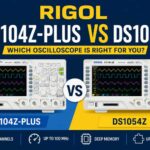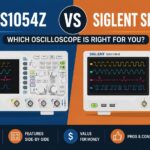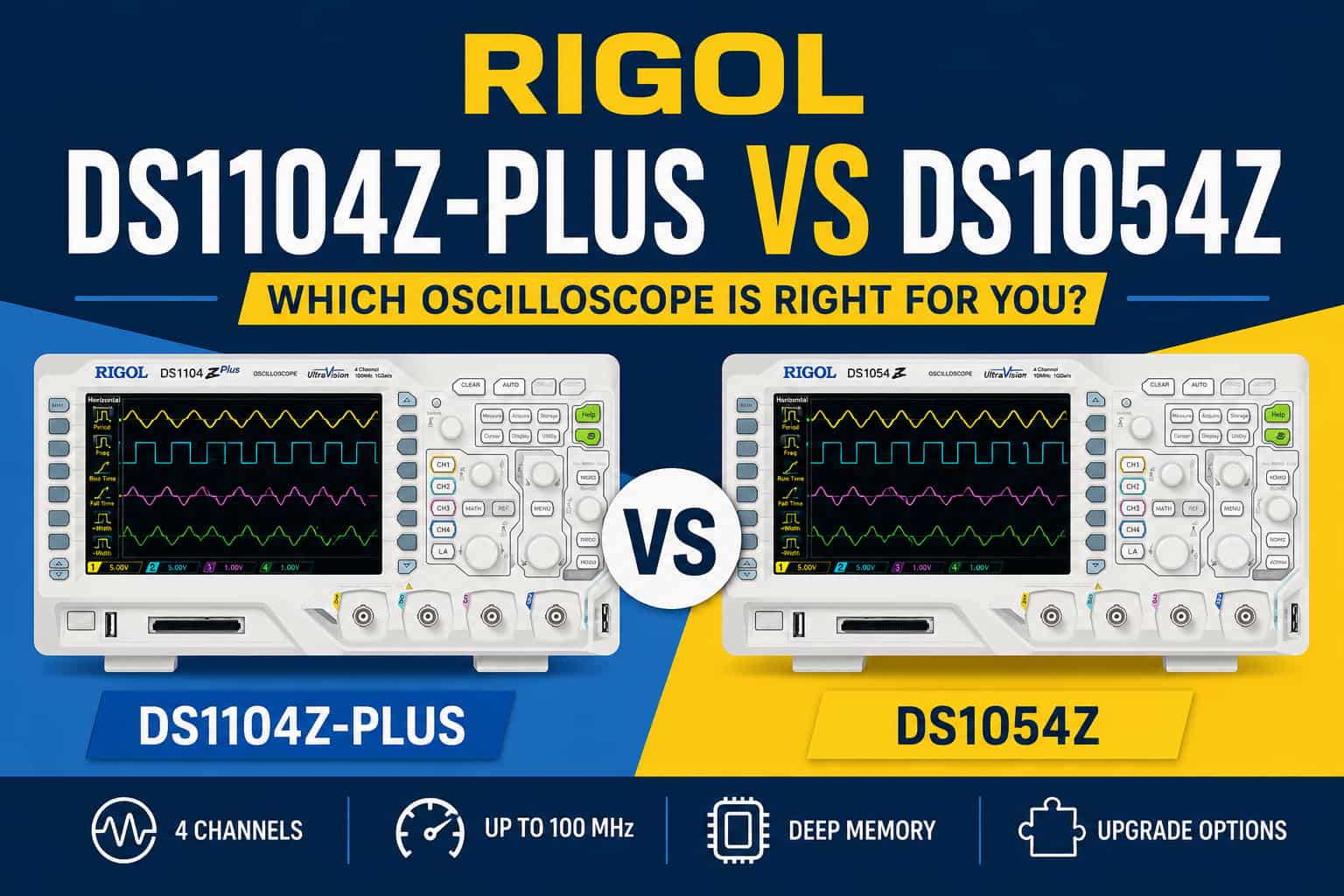
The Rigol DS1104Z-Plus and DS1054Z are the same oscilloscope twice, built on the same hardware platform, running the same firmware, sharing the same display, ADC, sample rate, and UltraVision acquisition engine. Rigol designed the entire DS1000Z family this way deliberately. Understanding that fact is the most useful starting point for this comparison, because once you know it, the differences between the two instruments come into sharp focus.
The DS1054Z ships at 50 MHz. The DS1104Z-Plus ships at 100 MHz. The Plus designation adds MSO readiness — a hardware connector that accepts the optional RPL1116 logic probe, unlocking 16 digital channels for mixed-signal work. Everything else is identical.
📊 Quick Recommendation
If you’re deciding between the Rigol DS1104Z Plus and the DS1054Z, the choice comes down to budget versus future-proofing.
|
🏆 Best Overall Rigol DS1104Z Plus 100 MHz bandwidth and upgradeable MSO capabilities. Check Price → |
💰 Best Value Rigol DS1054Z The legendary 4-channel oscilloscope for hobbyists and engineers. Check Price → |
🚀 Upgrade Pick Rigol DHO914 Modern 12-bit oscilloscope with lower noise and a faster interface. Check Price → |
That is the entire comparison in two sentences. The rest of this article explains what those differences mean in practice, what the bandwidth unlock modification on the DS1054Z means for buyers considering it, and which instrument makes sense for which buyer.
Same Hardware Platform
Both instruments use the same 1 GSa/s ADC, the same 7-inch 800×480 WVGA display with UltraVision intensity grading, the same 12 Mpts standard memory (upgradeable to 24 Mpts), the same 30,000 wfm/s waveform capture rate, and the same front panel layout. The serial decoding options, trigger functions, connectivity (USB, LAN, AUX), and measurement capabilities are identical. Both include optional serial bus analysis (I2C, SPI, UART/RS232) as paid add-ons, though current shipping configurations have frequently bundled these at no additional cost — verify at time of purchase.
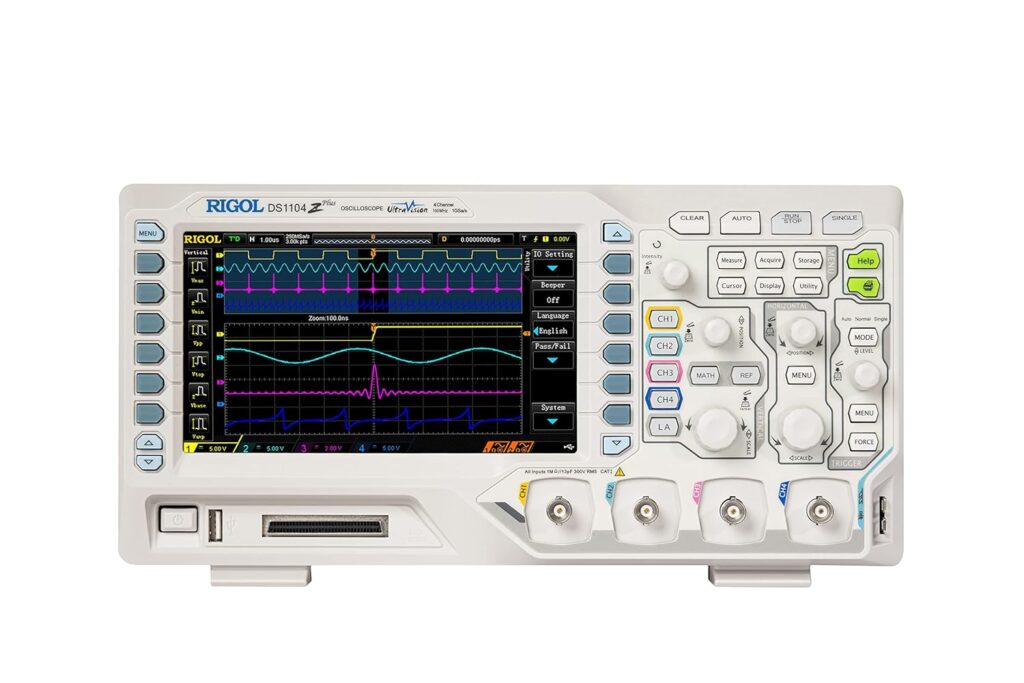
Both instruments deliver the same waveform quality, the same noise floor, the same measurement accuracy, and the same user experience. There is no meaningful quality difference between the DS1054Z and DS1104Z-Plus beyond the two specifications listed above.
Bandwidth: 50 MHz vs 100 MHz
The DS1054Z nominally operates at 50 MHz. This means the instrument’s analogue front end begins attenuating signals above roughly 35–40 MHz and reaches its rated -3 dB point at 50 MHz. For work at audio frequencies, power supply monitoring, I2C and SPI at typical speeds, UART, and most general microcontroller debugging, 50 MHz is adequate.
The DS1104Z-Plus ships at 100 MHz. This doubles the usable frequency range and is the specification that matters most when comparing the two instruments honestly.
🏆 Rigol DS1104Z Plus
The DS1104Z Plus is the better long-term investment. It provides the full 100 MHz bandwidth out of the box while retaining the excellent four-channel architecture and deep memory that made the DS1000Z series so popular.
- ✔ Factory 100 MHz bandwidth
- ✔ 4 analog channels
- ✔ 1 GSa/s sample rate
- ✔ Deep memory
- ✔ Upgradeable to MSO with logic probes
- ✔ Excellent for embedded systems and power electronics
The DS1054Z bandwidth unlock. A widely documented firmware modification exists that unlocks the DS1054Z to 100 MHz. The DS1000Z hardware is physically capable of 100 MHz — Rigol uses the same analogue front end across the bandwidth variants and limits lower models in software. The modification is performed by entering a menu accessible at startup, entering a licence key generated from the instrument’s serial number, and writing the new bandwidth value. It is not destructive to the hardware and can be reversed. Thousands of users have performed it successfully and the process is documented in detail on EEVblog and other electronics forums.
💰 Rigol DS1054Z
The DS1054Z remains one of the best-value oscilloscopes ever made. It delivers four channels, excellent protocol decoding, and enough performance for most hobbyists, students, and embedded engineers at a lower price.
- ✔ Lowest-cost 4-channel Rigol scope
- ✔ Excellent community support
- ✔ Great for Arduino, ESP32 and Raspberry Pi
- ✔ Proven reliability
- ✔ Outstanding value
The modification voids the Rigol warranty. For a hobbyist or home user, the warranty on an entry-level oscilloscope is not typically a deciding factor. For a company instrument, an educational institution, or anyone who needs a calibration certificate that matches the instrument’s stated specification, the modification is not appropriate.
If you are comfortable performing the unlock and operating outside warranty, the DS1054Z at 100 MHz and the DS1104Z-Plus at 100 MHz are functionally identical in their analogue acquisition — with one exception: the MSO capability.
The MSO Upgrade Path
The “Plus” in DS1104Z-Plus refers specifically to the presence of a logic connector on the rear of the instrument that accepts the RPL1116 digital probe. This probe adds 16 digital channels, turning the oscilloscope into a mixed-signal oscilloscope (MSO) capable of simultaneous analogue and digital signal capture.
The DS1054Z does not have this connector. No modification enables it. If you need MSO capability now or anticipate needing it, the DS1054Z is not the instrument to buy regardless of the bandwidth question.
🚀 Upgrade Pick: Rigol DHO914
If you’re buying a new oscilloscope today and your budget allows it, the DHO914 is worth considering. It brings Rigol’s latest hardware platform with a 12-bit ADC, significantly lower noise, improved waveform fidelity, and a much more responsive user interface.
- ✔ Modern 12-bit architecture
- ✔ Much lower noise floor
- ✔ Better waveform detail
- ✔ Improved display and UI
- ✔ Ideal for professional labs
MSO capability is most valuable for embedded systems work: watching a microcontroller’s SPI bus while simultaneously viewing the analogue supply voltage, correlating a digital state machine with an analogue output, or debugging hardware where timing relationships between digital control signals and analogue responses are the thing you need to understand. For purely analogue work or simple digital debugging, it is unnecessary.
Waveform Capture Rate and Memory
Both instruments share 30,000 wfm/s and 12 Mpts (upgradeable to 24 Mpts). These figures are competitive for instruments in this class but trail the Siglent SDS1104X-E’s 100,000 wfm/s normal mode and 14 Mpts. If capture rate and memory depth are your primary concerns, the Siglent platform is worth considering alongside either Rigol.
Sample Rate Behaviour with Multiple Channels
Both instruments share the same single-ADC architecture with the same channel-sharing behaviour. Maximum 1 GSa/s with one channel active, 500 MSa/s with two channels, 250 MSa/s with all four channels active. This is a hardware constraint common to the entire DS1000Z platform.
Serial Decoding
Both instruments support the same optional serial bus decoding. Rigol’s current shipping configuration typically includes the decode options as pre-installed on new units, but this has varied over the platform’s history. Both support I2C, SPI, and UART/RS232. Neither includes CAN or LIN decode as standard, which is a limitation compared to Siglent instruments at similar pricing.
Price
The DS1054Z typically sells for $349–399. The DS1104Z-Plus typically sells for $399–499, with the exact gap varying by retailer, configuration, and bundled options. In many markets the price difference is $50–100. Given that the Plus provides twice the bandwidth and the MSO upgrade path, the premium is difficult to justify against the DS1054Z unless the bandwidth unlock is planned from the start.
If you intend to unlock the DS1054Z to 100 MHz and never need MSO capability, the $50–100 price difference buys you a valid warranty and the manufacturer’s blessing to call the instrument a 100 MHz scope. Whether that is worth the premium is a personal decision.
Comparison Table
| Feature | Rigol DS1054Z | Rigol DS1104Z-Plus |
|---|---|---|
| Bandwidth | 50 MHz (100 MHz via modification) | 100 MHz (standard) |
| Channels (analogue) | 4 | 4 |
| MSO upgrade path | No | Yes (RPL1116 probe, 16 digital ch) |
| Max sample rate (1 ch) | 1 GSa/s | 1 GSa/s |
| Sample rate (4 ch) | 250 MSa/s | 250 MSa/s |
| Memory depth | 12 Mpts (24 Mpts option) | 12 Mpts (24 Mpts option) |
| Waveform capture rate | 30,000 wfm/s | 30,000 wfm/s |
| Display | 7″ 800×480 UltraVision | 7″ 800×480 UltraVision |
| Serial decoding | Optional (I2C, SPI, UART) | Optional (I2C, SPI, UART) |
| Advanced triggering | Optional | Optional |
| LAN/USB connectivity | Yes | Yes |
| Waveform record/replay | Optional | Optional |
Pros and Cons
Rigol DS1054Z — Pros
- Lowest price of the two instruments
- Identical hardware platform, identical software capability
- Massive community, years of documentation and tutorials
- Bandwidth unlock to 100 MHz is well-documented and widely used
- Largest accessory and software ecosystem of any budget oscilloscope
Rigol DS1054Z — Cons
- 50 MHz standard bandwidth requires modification for 100 MHz
- No MSO upgrade path under any circumstances
- No CAN or LIN serial decode
- 30,000 wfm/s capture rate trails Siglent competition
Rigol DS1104Z-Plus — Pros
- 100 MHz bandwidth standard, no modification required
- MSO upgrade path available via RPL1116 probe
- Full warranty maintained at 100 MHz
- Calibration certificate matches stated specification
- Same hardware platform, same proven reliability
- All software options available identically to DS1054Z
Rigol DS1104Z-Plus — Cons
- Higher price than DS1054Z
- MSO capability requires additional purchase of RPL1116 probe
- No CAN or LIN serial decode
- Same 30,000 wfm/s capture rate as DS1054Z — no improvement there
- Siglent SDS1104X-E matches bandwidth at similar price with better capture rate and deeper memory
Who Should Buy Which
The DS1054Z is the right choice in two situations. The first is simple price constraint: if the difference between the two instruments represents a meaningful portion of your budget, the DS1054Z delivers identical capability in practice for less money. The second is comfort with the bandwidth unlock: if you are a hobbyist who will perform the modification, operate outside warranty without concern, and have no need for MSO capability, the DS1054Z unlocked to 100 MHz is functionally the same instrument as the DS1104Z-Plus for less money.
The DS1104Z-Plus is the right choice if any of the following apply: you need 100 MHz bandwidth without voiding a warranty, you work in an environment where the instrument’s stated specification must match its calibration certificate, you anticipate wanting MSO capability now or in the future, or the price premium is small enough relative to total project costs that clean specifications matter more than marginal savings.
One additional consideration worth stating plainly: at the DS1104Z-Plus price point, the Siglent SDS1104X-E is a direct competitor offering 100 MHz bandwidth standard, 100,000 wfm/s capture rate, and 14 Mpts of memory — all of which beat the Rigol platform at equivalent or lower cost. If you are spending DS1104Z-Plus money and MSO capability is not a priority, the Siglent deserves serious consideration before the Rigol.
For buyers who are committed to the Rigol platform — perhaps because of the existing community, existing accessories, or specific Rigol software features — the DS1104Z-Plus is the cleaner purchase. For buyers open to either brand, the Siglent SDS1104X-E is the stronger instrument at this price.