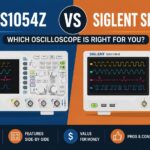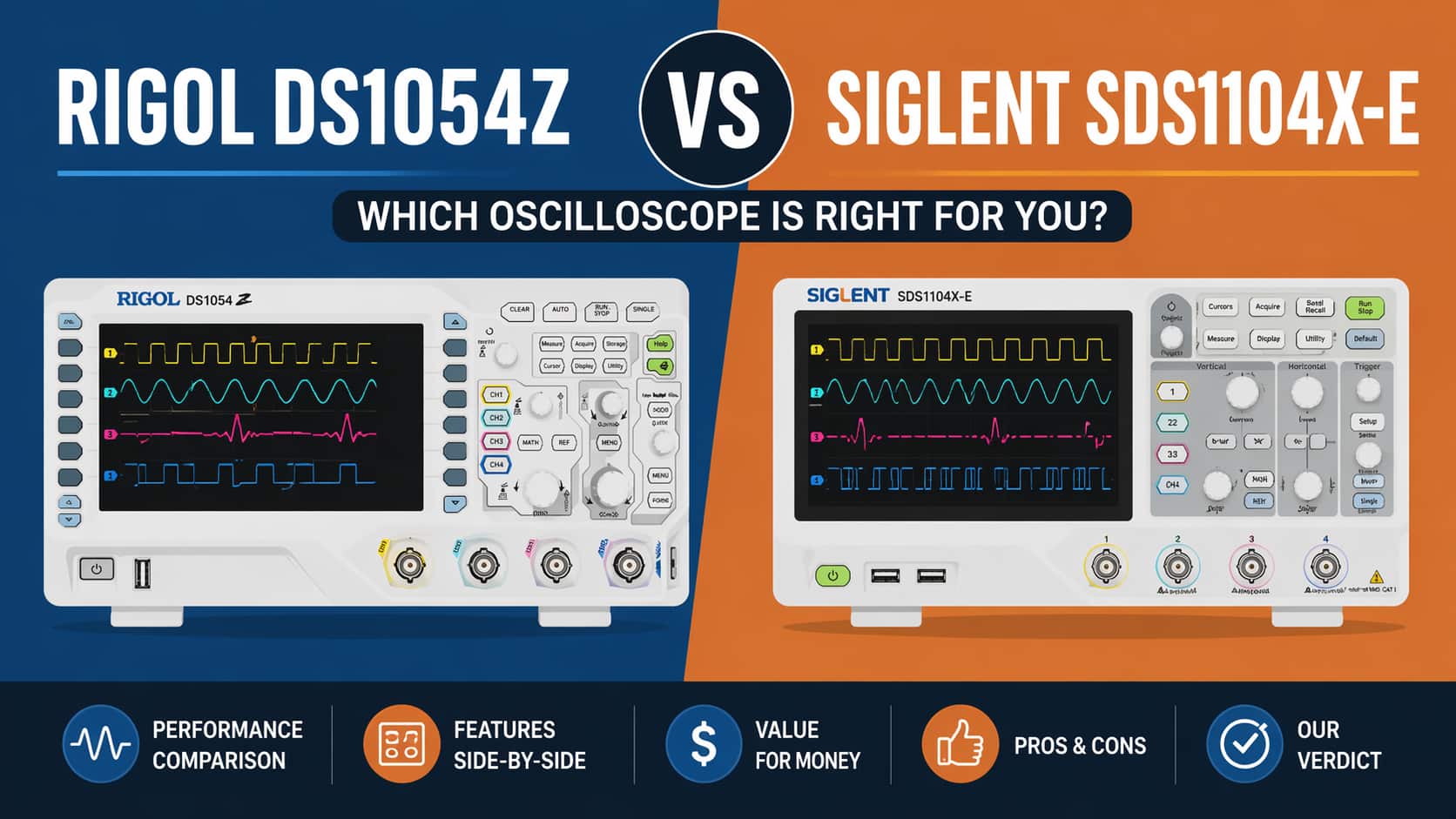
The Rigol DS1054Z and the Siglent SDS1104X-E occupy neighbouring shelves in the budget oscilloscope market and are frequently compared by the same buyers: electronics students, hobbyists, SDR experimenters, and working engineers who need a capable bench instrument without spending serious money. Both are four-channel digital storage oscilloscopes in a similar price bracket, both are made in China, and both have accumulated large and active user communities over the years they have been on the market.
A proven entry-level oscilloscope with four channels, deep memory and an exceptionally large community of tutorials, videos and troubleshooting resources.
- 50 MHz standard bandwidth
- 1 GSa/s maximum sample rate
- 12 Mpts standard memory
- Large beginner support community
The stronger all-round instrument for engineering, automotive, RF, power-electronics and embedded-system work where bandwidth and glitch capture matter.
- 100 MHz bandwidth from the factory
- Up to 400,000 waveforms per second
- 500 MSa/s with all four channels active
- CAN and LIN decoding included
Check Amazon for current pricing, availability and included software options.
The comparison is not as close as it first appears. The Siglent is a meaningfully more capable instrument in almost every measurable specification. Whether that matters for your use case is the real question.
Comparison Table
| Feature | Rigol DS1054Z | Siglent SDS1104X-E |
|---|---|---|
| Bandwidth | 50 MHz (100 MHz via modification) | 100 MHz (standard) |
| Channels | 4 | 4 |
| Max sample rate (1 ch) | 1 GSa/s | 1 GSa/s |
| Sample rate (4 ch) | 250 MSa/s | 500 MSa/s |
| Memory depth | 12 Mpts (24 Mpts option) | 14 Mpts (7 Mpts with 4 ch) |
| Waveform capture rate | 30,000 wfm/s | 100,000 / 400,000 wfm/s |
| Min vertical sensitivity | 1 mV/div | 500 µV/div |
| Serial decoding | Optional (I2C, SPI, UART) | Standard (I2C, SPI, UART, CAN, LIN) |
| Display | 7″ 800×480, intensity grading | 7″ 800×480, 256-level SPO, colour temperature |
| FFT | Standard | 1 Mpt FFT (hardware co-processor) |
| Bode plot | No | Yes (with compatible AWG) |
| Web browser remote control | No | Yes |
| Wi-Fi | No | Optional dongle |
| Community and resources | Very large | Large and growing |
| Price (approx.) | $349–399 | $399–499 |
Bandwidth
The DS1054Z ships at 50 MHz. This is Rigol’s stated specification and it is the bandwidth you get out of the box. A well-documented hardware modification exists that unlocks the instrument to 100 MHz, the underlying hardware is capable of it and Rigol sold higher-bandwidth variants of the same platform, but the modification voids your warranty and is not something every buyer will want to do on a new instrument. If you need 100 MHz cleanly and without fuss, you need to account for that in your decision.
Confirm the included software options and warranty before ordering.
The SDS1104X-E ships at 100 MHz from the factory with no modification required. For users working above 50 MHz – RF circuits, faster digital signals, power electronics; this is a genuine difference rather than a specification footnote.
Sample Rate and ADC Architecture
Both instruments nominally offer 1 GSa/s maximum sample rate, but the architecture behind that number differs in an important way.
The DS1054Z uses a single ADC shared across its four channels. When you activate multiple channels, the sample rate drops: 500 MSa/s with two channels active, 250 MSa/s with three or four channels active. This is standard practice for instruments in this price tier but it is worth understanding before you assume 1 GSa/s is always available.
The SDS1104X-E uses two independent ADCs paired with two memory modules. When channels are paired (one per ADC), each channel maintains 1 GSa/s and 14 Mpts. When all four channels are active, each drops to 500 MSa/s and 7 Mpts. This is a more generous architecture than the Rigol’s and means you lose less performance when working with multiple channels simultaneously.
Check current pricing, stock status and included accessories on Amazon.
Memory Depth
The DS1054Z offers 12 Mpts standard, upgradeable to 24 Mpts with an optional paid licence. In Rigol’s current shipping configuration, all options including deep memory come factory-installed, but verify this at the time of purchase as it has varied historically.
The SDS1104X-E provides 14 Mpts per channel (single channel per ADC) and 7 Mpts per channel with all four active, with no additional licence required. Deeper memory lets you capture longer time windows at a given sample rate, which matters when you are trying to observe an infrequent event in a long sequence of signal.
Waveform Capture Rate
This is one of the most significant practical differences between the two instruments and one of the least discussed in spec comparisons.
The DS1054Z achieves a maximum waveform capture rate of 30,000 waveforms per second. This is adequate for most general-purpose debugging work.
The SDS1104X-E achieves 100,000 waveforms per second in normal mode and 400,000 waveforms per second in sequence mode. A higher capture rate means the oscilloscope samples the signal more often in real time, which dramatically improves your odds of catching rare glitches, runt pulses, intermittent faults, and transient anomalies. If you are debugging a system that fails occasionally and unpredictably, this difference is not marginal — it can be the difference between seeing the fault and missing it entirely.
Vertical Sensitivity
The DS1054Z’s minimum vertical sensitivity is 1 mV/div. The SDS1104X-E reaches 500 µV/div, giving it twice the vertical resolution at the most sensitive end of its range. For users measuring small signals, low-amplitude noise, or fine detail on slow signals, this matters. For most general debugging at typical logic and analogue signal levels, it is not a deciding factor.
Serial Decoding
The DS1054Z originally required a paid software upgrade to enable serial bus decoding for I2C, SPI, and UART. Rigol has at various points bundled this option with new units, but the history has been inconsistent and worth confirming at purchase. Even with the option enabled, the supported protocols are RS232, I2C, and SPI.
The SDS1104X-E includes serial decoding as standard with no additional licence, covering I2C, SPI, UART, CAN, and LIN out of the box. The inclusion of CAN and LIN is a meaningful addition for automotive and industrial work that the Rigol does not match in its standard configuration.
Display and Interface
Both instruments use a 7-inch 800 x 480 display. The SDS1104X-E’s SPO (Super Phosphor Oscilloscope) technology provides 256-level intensity grading and a colour temperature display mode, which renders waveforms in a way that visually conveys signal density and event frequency in a manner closer to an analogue oscilloscope. The Rigol uses multi-level intensity grading as well but the Siglent’s implementation is generally regarded as more refined by the community that has used both.
The SDS1104X-E also includes a built-in web browser interface for remote control over LAN, a Bode plot function (when paired with a compatible Siglent function generator), and a history function that lets you scroll back through captured waveforms. These are not features available on the base DS1054Z.
Connectivity
Both instruments provide USB host and device ports and a LAN (Ethernet) connection. The SDS1104X-E adds an optional Wi-Fi dongle and the web-based remote control interface mentioned above. Both support SCPI commands over LAN for integration with test automation.
Price
The DS1054Z typically sells for around $349–399 USD depending on the retailer and configuration. The SDS1104X-E typically sells for $399–499 USD. The price gap has narrowed over time and is not always as wide as the specification gap might suggest. At current pricing, the Siglent delivers substantially more instrument per dollar in terms of raw specification.
You are buying your first oscilloscope, primarily work below 50 MHz, want four channels at the lowest practical cost and value access to a huge library of tutorials and community support.
Check Rigol DS1054Z PriceYou want the more capable long-term instrument for embedded, automotive, RF or power-electronics work and need better odds of catching rare glitches and transient events.
Check Siglent SDS1104X-E PriceVerify the exact model, included probes, software features and warranty before purchasing.
Who Should Buy Which
The DS1054Z remains a compelling choice in one specific situation: you are a student or beginner buying your first oscilloscope, budget is the primary constraint, and you expect to work primarily with low-frequency analogue and digital signals below 50 MHz. The Rigol’s large community, extensive YouTube tutorial library, and decade of forum documentation mean that almost every question a new user could ask has already been answered somewhere. That support infrastructure has real value when you are learning.
The SDS1104X-E is the stronger instrument for everyone else. The 100 MHz bandwidth without requiring a modification, the substantially higher waveform capture rate, the better multi-channel sample rate architecture, the standard serial decoding for CAN and LIN, and the lower minimum vertical sensitivity collectively represent a meaningfully more capable scope at a price premium that has narrowed to the point where it is difficult to justify the Rigol on specification grounds alone. For RF experimentation, automotive electronics, power electronics, or any application where glitch capture matters, the Siglent is the cleaner choice.
The DS1054Z is not a bad oscilloscope. It was a benchmark instrument at its launch and it remains capable. The SDS1104X-E is simply a better one at nearly the same price, and the market has had long enough to verify that.