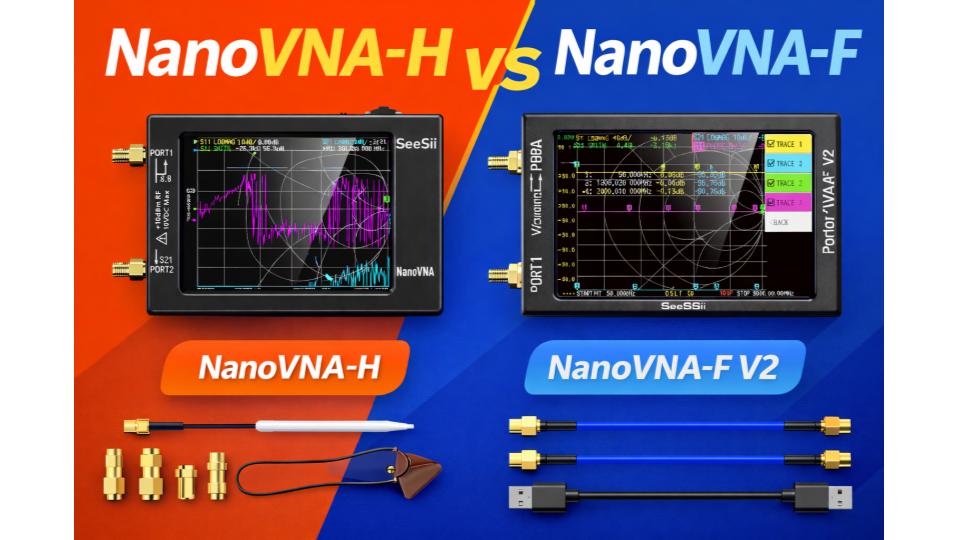
Both the NanoVNA-H and NanoVNA-F descend from the same open-source project, the original NanoVNA created by edy555, but they were developed by different engineers with different priorities. The result is two instruments that share the same underlying measurement architecture but differ meaningfully in physical design, display, battery, and who they are best suited for. If you are deciding between them, the differences matter more than the marketing might suggest.
Quick Recommendation
NanoVNA-H is the best choice if you want the most portable and affordable NanoVNA for bench work or learning RF measurements.
NanoVNA-F is the better choice if you want a larger display, longer battery life, and a more rugged aluminium enclosure for field use.
Origins and Developers
The NanoVNA-H was developed by Hugen (GitHub: hugen79), a Chinese engineer who took edy555’s original design, modified the circuit to add proper battery management, redesigned the PCB, added an internal metal shield to reduce interference, and improved the frequency algorithm to extend coverage using odd harmonics of the Si5351 clock generator.
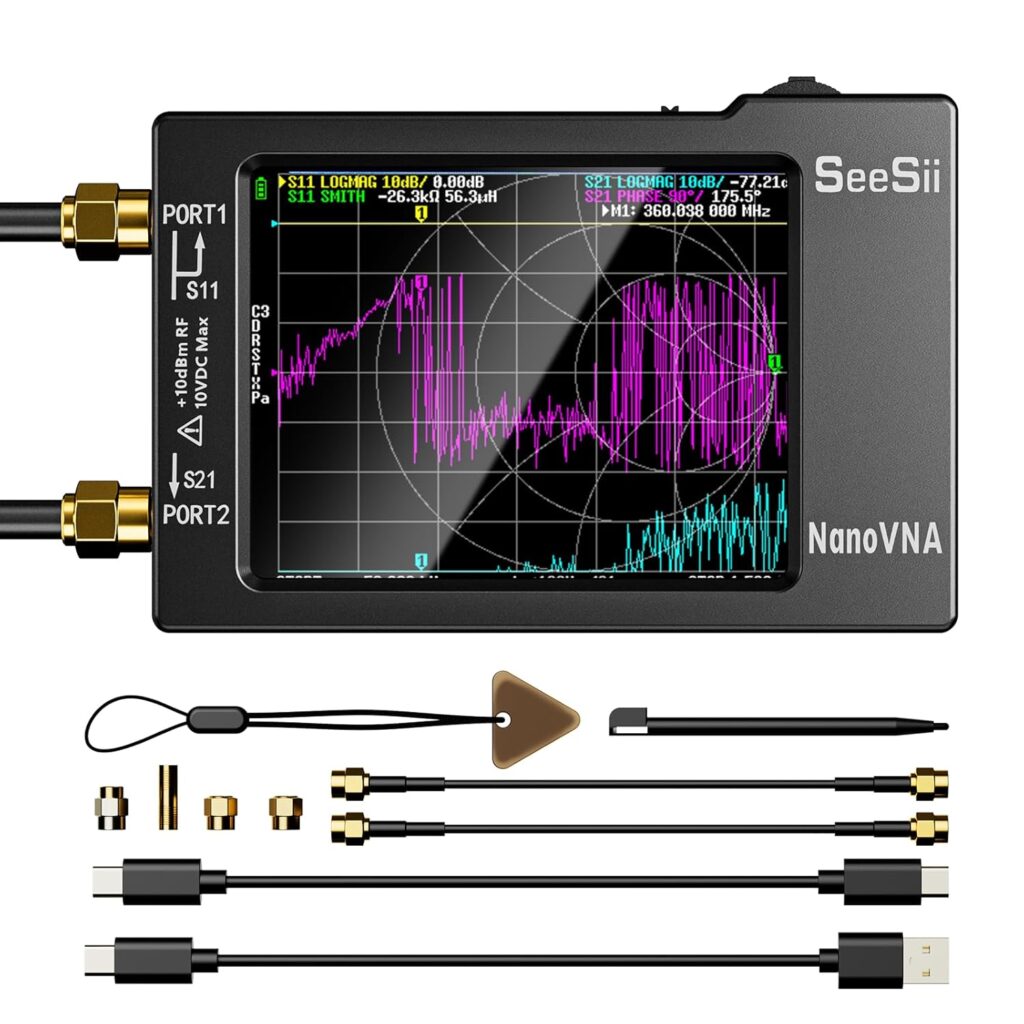
The H in the name stands for Hugen. Subsequent versions including the H4 variant moved to a more powerful STM32F303 processor. Hugen’s design is the closest to the original NanoVNA in form factor and spirit: small, pocketable, and focused on getting a working VNA into as many hands as possible at minimal cost.
NanoVNA-H
Best for: Beginners, portable use, and the lowest-cost entry into vector network analysis.
- 50 kHz – 1.5 GHz coverage
- Very compact and pocketable
- Large community and firmware support
- Excellent for antenna tuning and RF experimentation
The NanoVNA-F was developed by BH5HNU and commercialised through Deepelec (Hangzhou Minghong Electronic Technology Co., Ltd.). Where Hugen optimised for small size, BH5HNU optimised for usability: a larger and brighter screen, a much bigger battery, a more robust aluminium enclosure, and a cleaner out-of-box experience aimed at users who might use the instrument daily. The F is widely understood to stand for a larger form factor variant with a focus on field use.
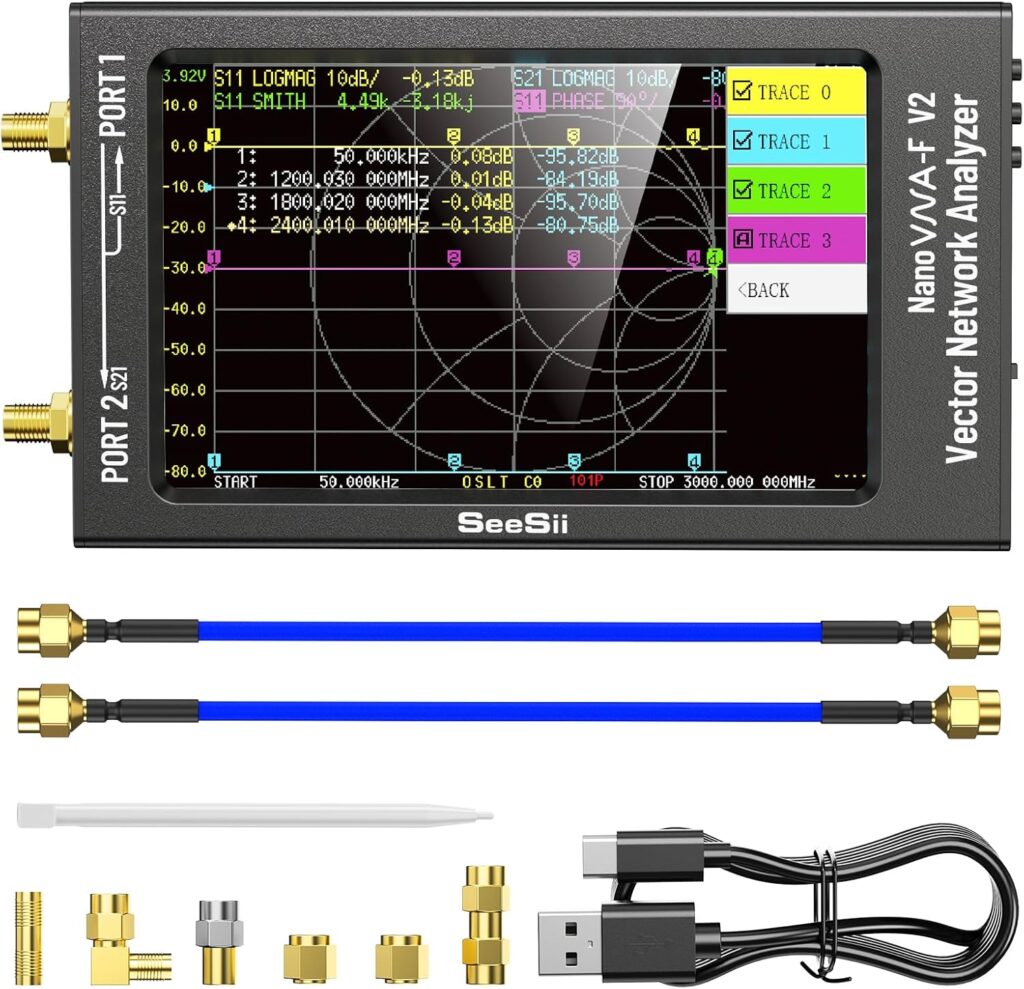
NanoVNA-F
Best for: Field work, larger screen readability, and longer battery life.
- 4.3″ IPS display (much easier to read)
- Large 5000 mAh battery
- Aluminium enclosure for better shielding
- Ideal for outdoor antenna measurements
Shared Architecture
Both instruments use the same fundamental measurement technique. A Si5351A clock generator produces a test signal and a local oscillator signal spaced 6 kHz apart (some firmware versions use 10 kHz). The test signal passes through or reflects off the device under test, then mixes with the local oscillator in SA612 double-balanced mixer ICs to produce an intermediate frequency signal in the audio range. An audio codec chip digitises the mixer outputs, and an STM32 microcontroller computes the S-parameters. This is a homodyne receiver architecture running at a very low IF. Elegant and low-cost, but with performance constraints that increase at higher frequencies where harmonic content from the Si5351 becomes harder to filter.
Both devices use odd harmonics of the Si5351 to push frequency coverage beyond the direct output range: the third harmonic extends to around 900 MHz, the fifth to around 1.5 GHz. Dynamic range degrades as harmonic order increases, which is why both instruments quote different dynamic range numbers at different frequency bands.
Frequency Coverage and Dynamic Range
This is where the two devices are essentially equivalent:
Both cover 50 kHz to 1.5 GHz with the same tiered dynamic range: better than 70 dB from 50 kHz to 300 MHz, better than 60 dB from 300 MHz to 900 MHz, and better than 40 dB from 900 MHz to 1.5 GHz. The NanoVNA-F’s early firmware targeted 1 GHz as the practical upper limit (with 40 dB at that point), and later firmware extended coverage to 1.5 GHz. The NanoVNA-H reached 1.5 GHz from its rev3.5 hardware onward. In practice the two devices will give comparable measurement quality at any given frequency within this range, assuming similar calibration care.
RF output power is 0 dBm (±2 dBm) on both. Neither is going to drive a challenging load, and both benefit from good SMA cables and a clean SOLT calibration before serious work.
The Key Differences
Display
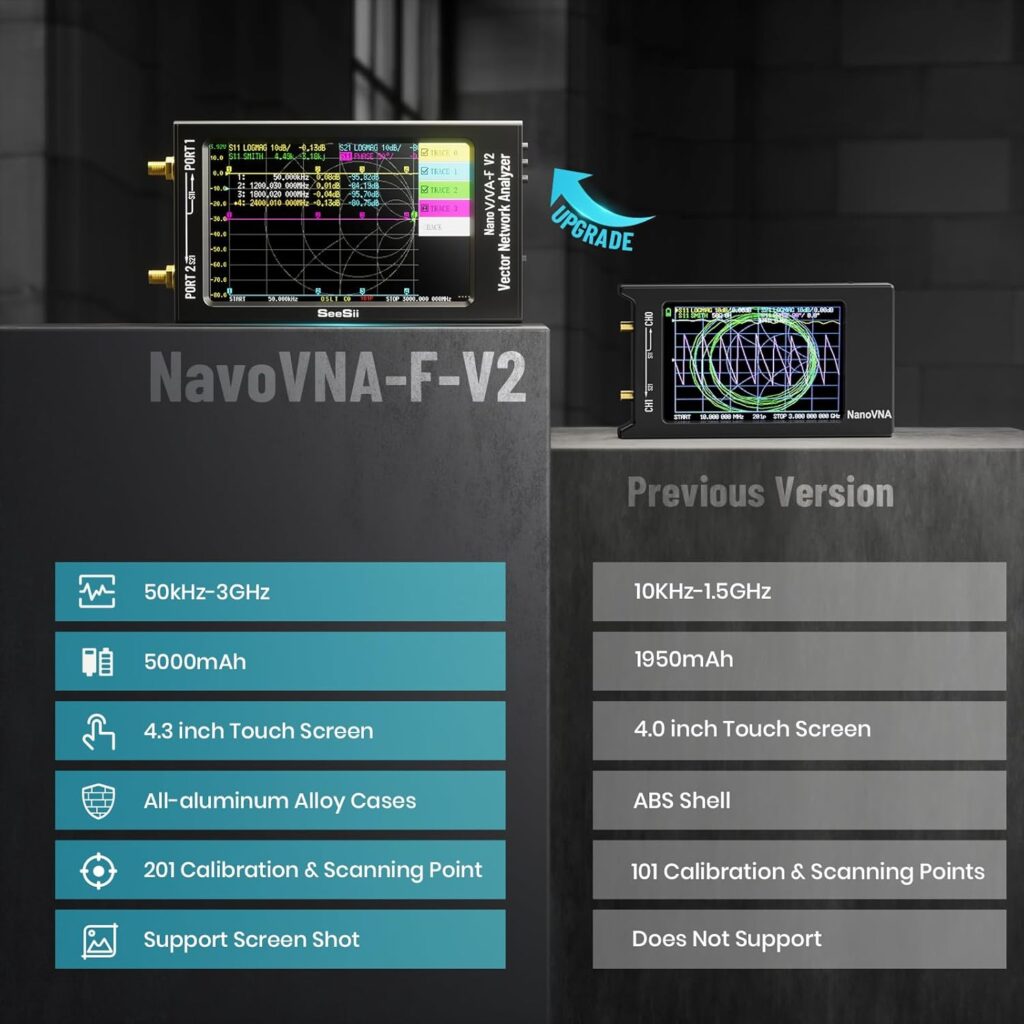
This is the most immediately obvious distinction. The NanoVNA-H uses a 2.8-inch TFT touchscreen at 320 x 240 resolution. The NanoVNA-H4 variant upgrades this to a 4-inch display at higher resolution, which significantly improves readability.
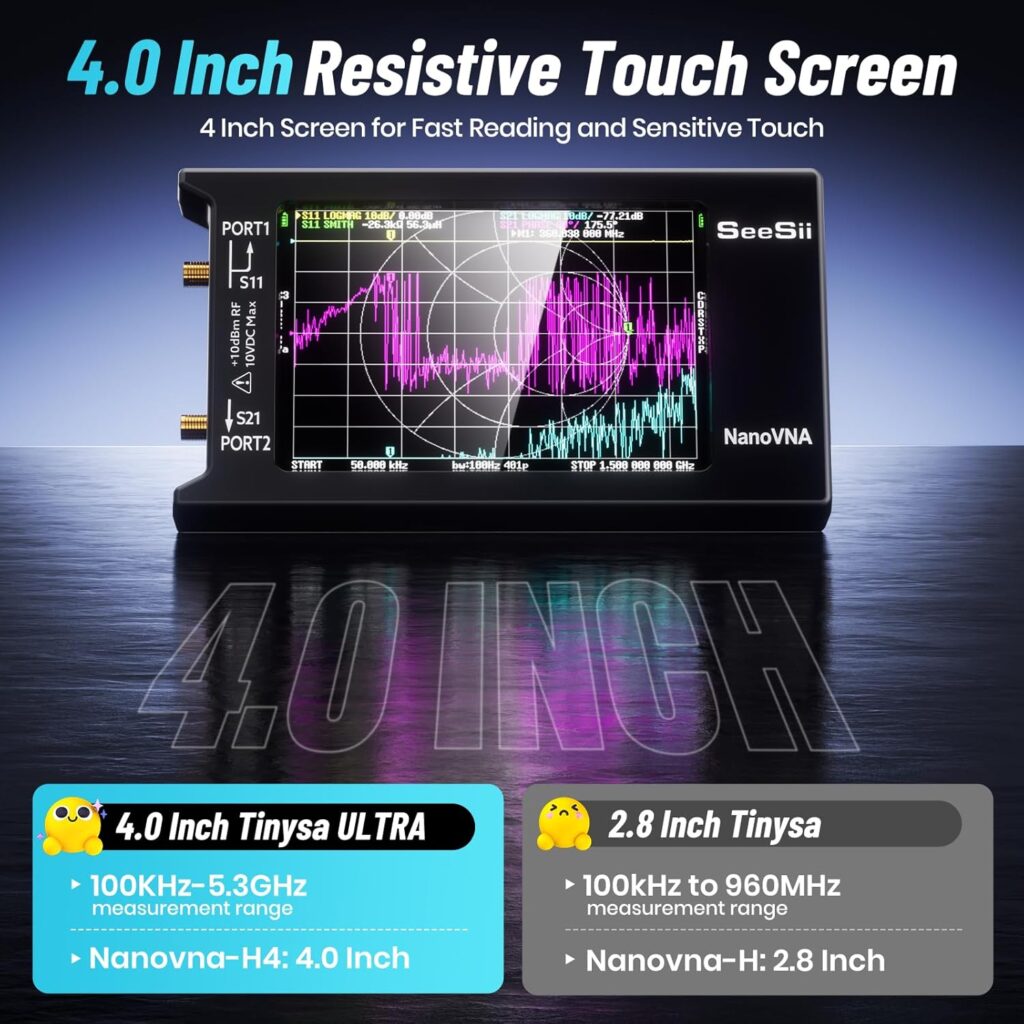
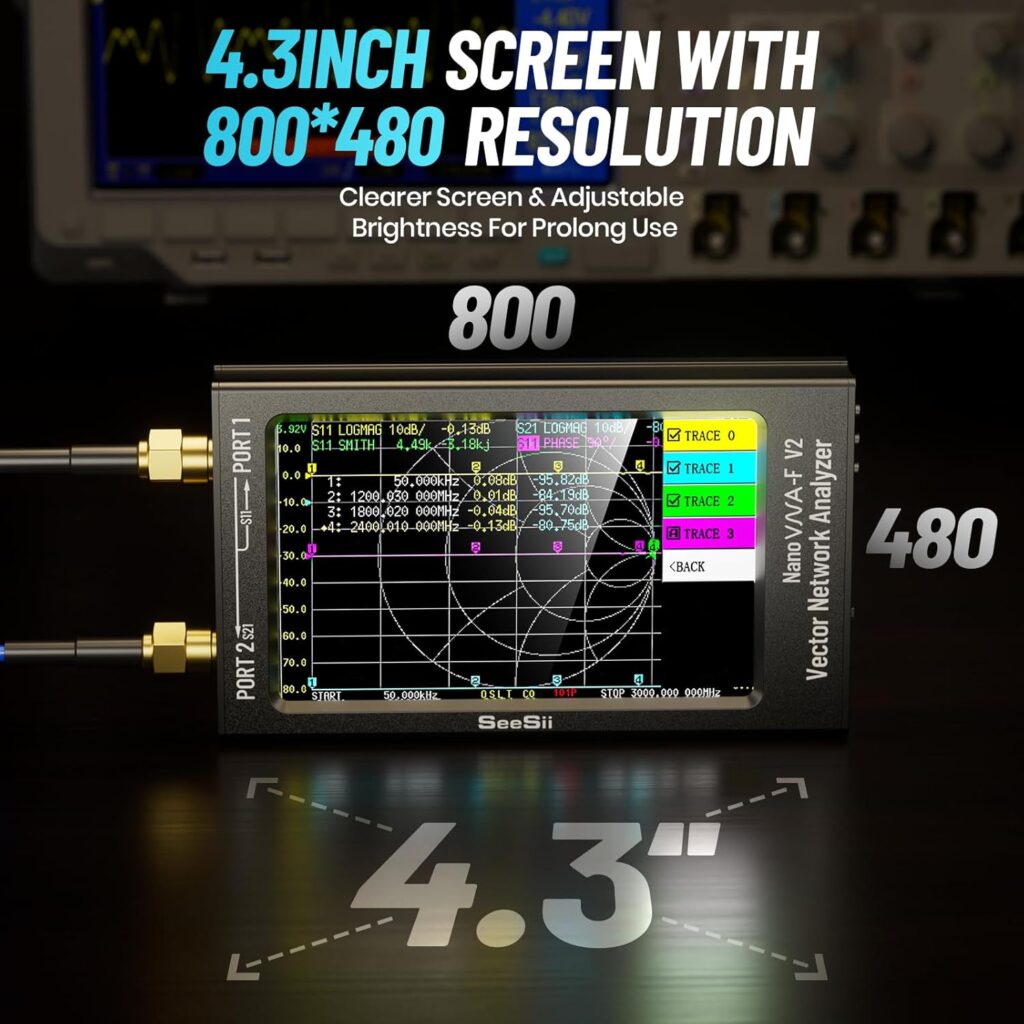
Smith charts in particular benefit from more screen real estate. The NanoVNA-F uses a 4.3-inch IPS TFT display at 800 x 480 resolution. IPS technology gives it wider viewing angles and better outdoor visibility compared to the standard TFT panels in the H variants. For anyone who works outdoors or needs to see detail in Smith chart plots, the NanoVNA-F’s display is a genuine advantage.
Battery Life
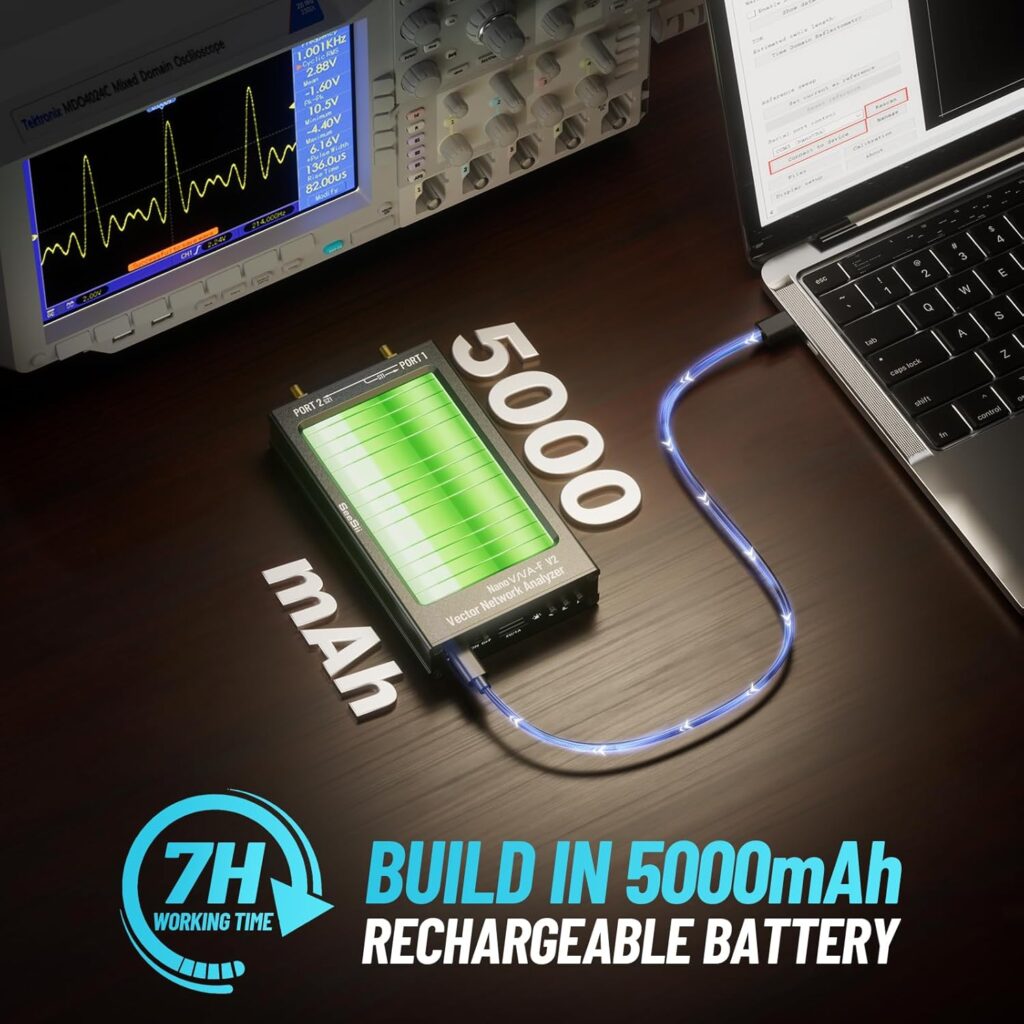
The NanoVNA-H ships with a 650 mAh battery, which gives roughly three to four hours of operation in typical use. The NanoVNA-H4 doubles this to 1,950 mAh for around eight hours. The NanoVNA-F goes significantly further with a 5,000 mAh battery; enough for a full day in the field and then some, and the unit can even act as a USB power bank when not in use. For bench work this rarely matters, but for anyone running measurements in an enclosure, on an antenna mast, or doing all-day fieldwork, the F’s battery capacity is a practical advantage.
Enclosure
The NanoVNA-H uses an ABS plastic case (some versions come bare PCB). It is lightweight and pocketable, roughly 86 x 52 x 16 mm. The NanoVNA-F uses an aluminium enclosure measuring approximately 140 x 75 x 20 mm, which is meaningfully larger and heavier but provides far better RF shielding, better protection against mechanical damage, and a more professional feel. The aluminium case matters if you are making measurements in electromagnetically noisy environments, ground loops and stray fields that would barely affect a well-shielded instrument can corrupt measurements on a plastc-cased device if you are not careful.
Processor and Firmware
The NanoVNA-H (original) runs an STM32F072 Cortex-M0 at 48 MHz with 16 KB SRAM and 128 KB flash. The NanoVNA-H4 upgraded to the STM32F303 Cortex-M4 at 72 MHz with 40 KB SRAM, 256 KB flash, and a floating point unit. A meaningful jump that enables more complex firmware features and faster sweep computation. The NanoVNA-F uses an STM32F103 Cortex-M3 at 72 MHz, sitting between the two H variants in raw performance but running its own firmware branch (FreeRTOS-based, maintained by BH5HNU at github.com/flyoob/NanoVNA-F) that is not interchangeable with Hugen’s firmware. This firmware split is worth understanding: the H and F devices are not firmware-compatible, and each has its own update ecosystem.
Scan Points and Measurement Speed
Both devices support 101 scan points in their standard firmware configuration. The NanoVNA-H4’s more powerful processor handles additional features including extended marker functionality and faster numerical computation, but the fundamental 101-point sweep limitation applies broadly across both families. NanoVNA-Saver software running on a connected PC can command multi-segment sweeps that effectively increase resolution at the cost of sweep time.
Control Interface
The NanoVNA-H uses a combination of physical navigation buttons and resistive touchscreen for menu navigation. The NanoVNA-F was produced in two hardware variants: one using a thumb-wheel (trackwheel) for navigation and one with push-buttons, both combined with the 4.3-inch resistive touchscreen. Resistive touch on both devices benefits from a stylus rather than bare fingers, especially at high resolution. Neither device has a rotary encoder with tactile detents in the way that many bench instruments do, so menu navigation takes some adjustment regardless of which you choose.
Software Compatibility
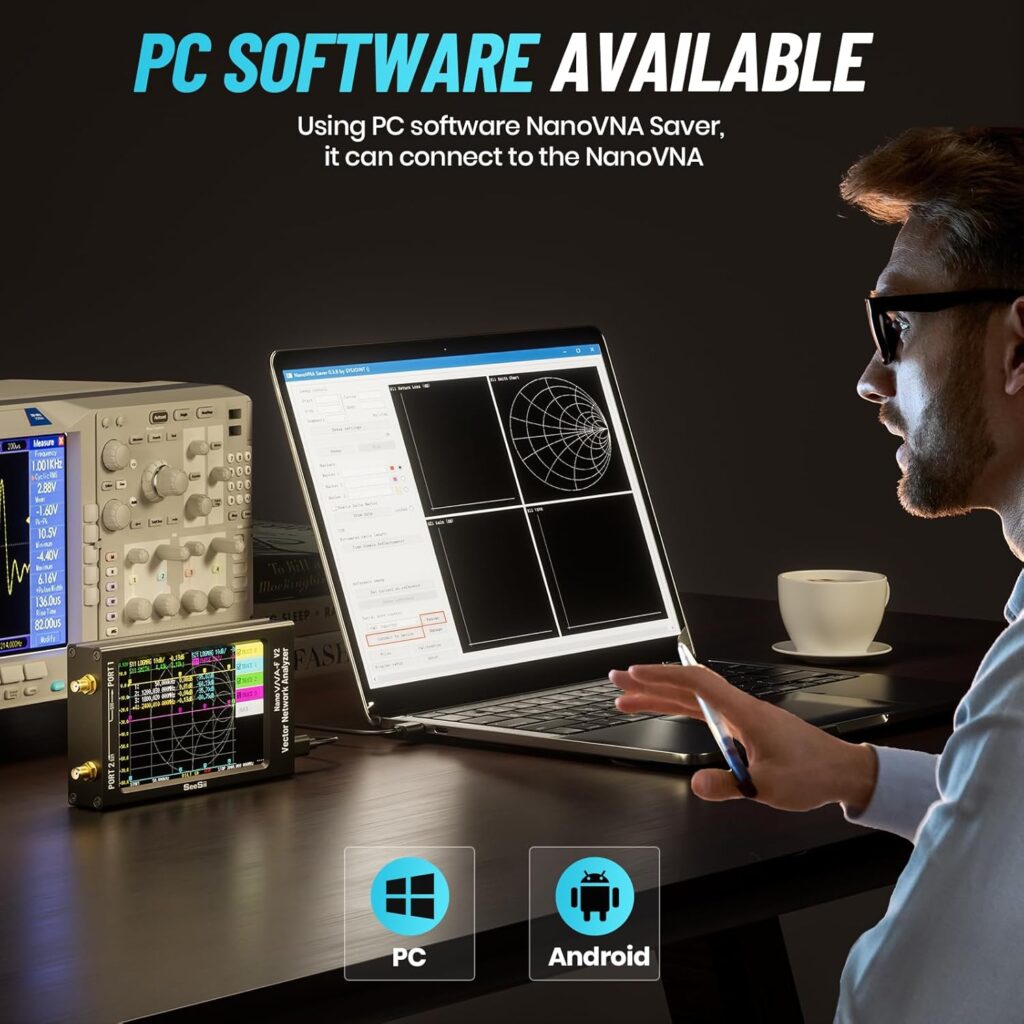
Both devices work with the same PC ecosystem. NanoVNA-Saver (by Rune B. Broberg, available at github.com/NanoVNA-Saver/nanovna-saver) runs on Windows, Linux, and macOS and provides multi-segment sweeps, Touchstone file export, TDR time domain analysis, and calibration management. Android apps are also available for both. The USB interface on both uses a virtual serial port over USB-C, which requires a driver on Windows 10 and older. Both support saving calibration data to five onboard memory slots.
Quick Comparison
| NanoVNA-H | NanoVNA-H4 | NanoVNA-F | |
|---|---|---|---|
| Developer | Hugen | Hugen | BH5HNU / Deepelec |
| Frequency range | 50 kHz–1.5 GHz | 50 kHz–1.5 GHz | 50 kHz–1.5 GHz |
| Dynamic range | 70/60/40 dB | 70/60/40 dB | 70/60/40 dB |
| Display | 2.8″ TFT 320×240 | 4.0″ TFT | 4.3″ IPS 800×480 |
| Battery | 650 mAh | 1,950 mAh | 5,000 mAh |
| Enclosure | ABS plastic | ABS plastic | Aluminium |
| Processor | STM32F072 (M0) | STM32F303 (M4) | STM32F103 (M3) |
| Scan points | 101 | 101 | 101 |
| Approximate size | 86 x 52 x 16 mm | 100 x 70 x 17 mm | 140 x 75 x 20 mm |
| Firmware | Hugen / community | Hugen / community | BH5HNU (FreeRTOS) |
NanoVNA-H vs NanoVNA-F
Choose NanoVNA-H if:
- You want the cheapest NanoVNA
- You prefer a small portable device
- You mainly use it on a bench
Choose NanoVNA-F if:
- You want a much larger display
- You do field measurements
- You want longer battery life
Who Should Buy Which
The NanoVNA-H is the right choice if you want the smallest, cheapest, most portable option and you will primarily use it on a bench where battery life and screen size are not limiting factors. It has the largest community, the most third-party firmware variants, and the most written documentation. If you are new to VNAs and want to get started with the lowest barrier to entry, start here.
The NanoVNA-H4 is the H with the upgrades most users eventually wish they had: a bigger screen and longer battery. It is the sensible step up if you already own an H and find the small display limiting, or if you know from the start that you will be doing extended field sessions.
The NanoVNA-F is the right choice if you work in the field regularly, if you need the best screen the Si5351-based NanoVNA platform offers, if you want an aluminium-shielded enclosure for noisy environments, or if all-day battery life matters to you. You pay more and carry something larger, but the instrument feels more finished and the display is genuinely better. The downside is the firmware ecosystem is smaller and the device is less pocketable.
None of these devices should be compared directly to a NanoVNA V2 Plus4 or LiteVNA64, which use fundamentally different and higher-performance RF front ends. If your work regularly takes you above 1.5 GHz or demands tighter dynamic range, those are different conversations.
Want Better Performance?
If you need better dynamic range or measurements above 1.5 GHz, consider upgrading to newer VNA designs such as:
- NanoVNA V2 Plus4
- LiteVNA64
These instruments use a different RF architecture and deliver much higher measurement accuracy.
See NanoVNA V2 Options on Amazon