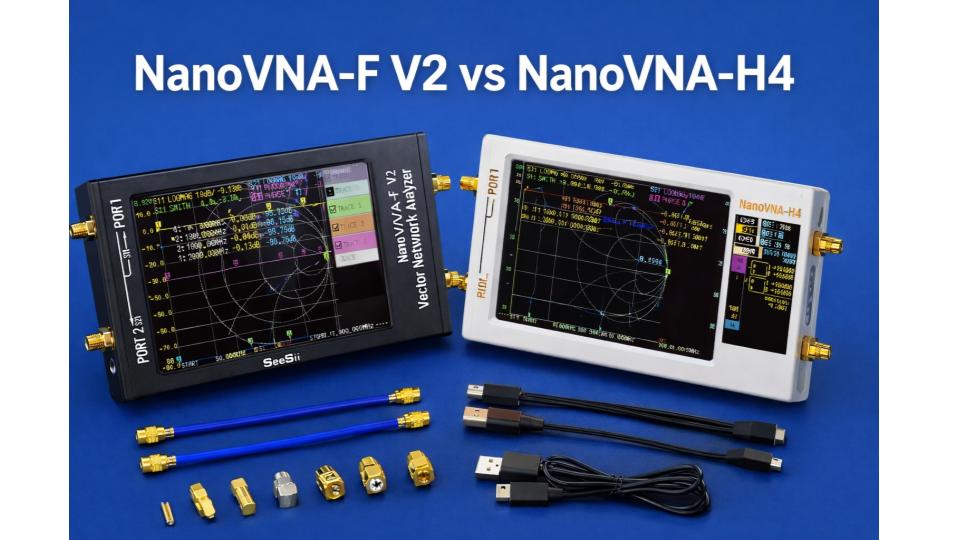
Both the NanoVNA-F V2 and the NanoVNA-H4 are portable vector network analysers that fit in a jacket pocket, cost under $100, and run on the same open-source software ecosystem. On a comparison table they look like close competitors. Under the hood they are fundamentally different instruments built around different RF architectures; and that difference determines which one belongs in your kit bag.
Where Each Device Comes From
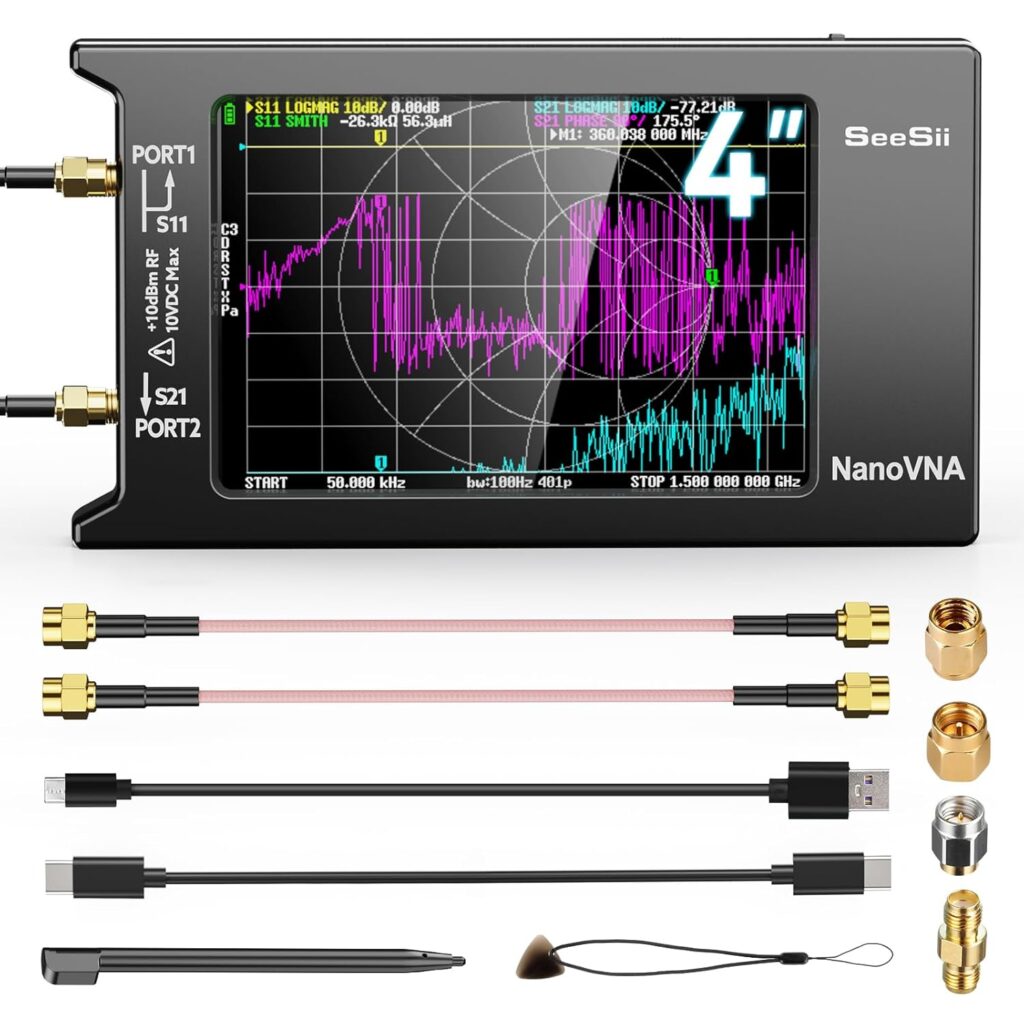
The NanoVNA-H4 is Hugen’s enlarged H-series device, carrying forward the same Si5351-based architecture that powered the original NanoVNA and its successors. Hugen took the original edy555 design, improved the PCB layout, added proper battery management and metal shielding, and scaled up the display to 4 inches for the H4 variant. The STM32F303 Cortex-M4 processor at 72 MHz with floating point hardware is a meaningful upgrade over the original H’s STM32F072, enabling more sophisticated firmware features. But the fundamental RF measurement approach – Si5351 clock generator, SA612 mixers, audio codec digitisation, is a direct evolution of the original design.
Best NanoVNA Options Right Now
| Product | Best For | Frequency Range | Action |
|---|---|---|---|
| NanoVNA-F V2 | Microwave measurements, Wi-Fi antennas, cellular filters | 50 kHz – 3 GHz | Check Price |
| NanoVNA-H4 | HF, VHF, UHF antennas and ham radio work | 50 kHz – 1.5 GHz | Check Price |
The NanoVNA-F V2 is a different story. BH5HNU and Chelegance took inspiration from both edy555’s original NanoVNA and OwOComm’s S-A-A-2 (NanoVNA V2) design and built something that bridges the two. The F V2 retains the form factor and user experience of the original NanoVNA-F — the same 4.3-inch IPS display, the same aluminium enclosure, the same 5,000 mAh battery — but replaces the Si5351-only RF front end with an ADF4350 fractional-N PLL synthesiser and an AD8342 active mixer. This is not an incremental update. It is a different instrument running a different RF architecture at a significantly different price point.
The Architecture Difference Is the Whole Story
This is the detail that matters most and gets discussed least in casual comparisons.
The NanoVNA-H4 generates its test signal and local oscillator using a Si5351A clock generator. The Si5351 is a capable and inexpensive device with a direct output range that comfortably covers frequencies to around 200 MHz. To extend coverage above that, the H4 — like all Si5351-based NanoVNAs — exploits the odd harmonics of the clock output: the third harmonic reaches to roughly 900 MHz, the fifth harmonic to 1.5 GHz. This is an ingenious technique, but it comes with real consequences. Harmonic signals carry the phase noise of the fundamental multiplied by the harmonic number squared. At the fifth harmonic the signal is weaker, noisier, and harder to filter than a fundamental output at the same frequency. Dynamic range degrades predictably as frequency rises, which is why the H4’s specifications are tiered: better than 70 dB from 50 kHz to 300 MHz, better than 60 dB from 300 to 900 MHz, and better than 40 dB from 900 MHz to 1.5 GHz. Above 1.5 GHz the H4 has nothing useful to offer.
NanoVNA-H4
The NanoVNA-H4 is the best entry point for RF work below 1.5 GHz. For HF, VHF, and UHF antennas, feedlines, and amateur radio filters, it provides excellent value and a huge firmware community.
- 50 kHz – 1.5 GHz frequency coverage
- Very strong HF / VHF / UHF performance
- Large NanoVNA firmware ecosystem
- Lower cost and widely available
The NanoVNA-F V2 uses an ADF4350 fractional-N integer-N PLL synthesiser from Analog Devices. The ADF4350 generates output on the fundamental frequency across its operating range up to approximately 4.4 GHz, with the F V2 specified to 3 GHz in practice. There are no harmonics involved in reaching 3 GHz — the PLL produces a clean fundamental output at every frequency across the sweep. This is why the F V2’s dynamic range tiers look different: S21 greater than 70 dB from 50 kHz to 1.5 GHz, greater than 60 dB from 1.5 to 3 GHz. S11 is 50 dB to 1.5 GHz and 40 dB to 3 GHz. The RF output power is -9 dBm across the range. The instrument also uses an AD8342 active mixer rather than the SA612 passive mixers used in the H-series, and the STM32’s internal ADC replaces the audio codec digitisation path of the older design. Every major RF component is an upgrade.
NanoVNA-F V2
The NanoVNA-F V2 uses a ADF4350 PLL synthesiser and AD8342 active mixer, giving it real calibrated measurements up to 3 GHz. If your work includes Wi-Fi, cellular, or microwave filters, this is the model that can actually measure them properly.
- 50 kHz – 3 GHz frequency range
- Fundamental-frequency measurements
- Better dynamic range above 1 GHz
- Aluminium enclosure and RG405 cables
The practical consequence is that measurements above 1.5 GHz on the F V2 are real, calibrated, useful data. Measurements above 1.5 GHz simply do not exist on the H4.
Frequency Coverage and Dynamic Range
| Band | NanoVNA-H4 | NanoVNA-F V2 |
|---|---|---|
| 50 kHz – 300 MHz | >70 dB | >70 dB (S21) |
| 300 – 900 MHz | >60 dB | >70 dB (S21) |
| 900 MHz – 1.5 GHz | >40 dB | >70 dB (S21) |
| 1.5 – 3 GHz | Not available | >60 dB (S21) |
| Above 3 GHz | Not available | Not available |
This comparison makes something clear that the headline frequency numbers obscure. At 1 GHz, the H4 is working at its fifth harmonic with 40 dB of dynamic range. The F V2 at 1 GHz is running a clean fundamental output with more than 70 dB of dynamic range. These are not equivalent instruments at that frequency.
Display, Battery, and Physical Design
Here the two devices are more evenly matched than their architectures suggest.
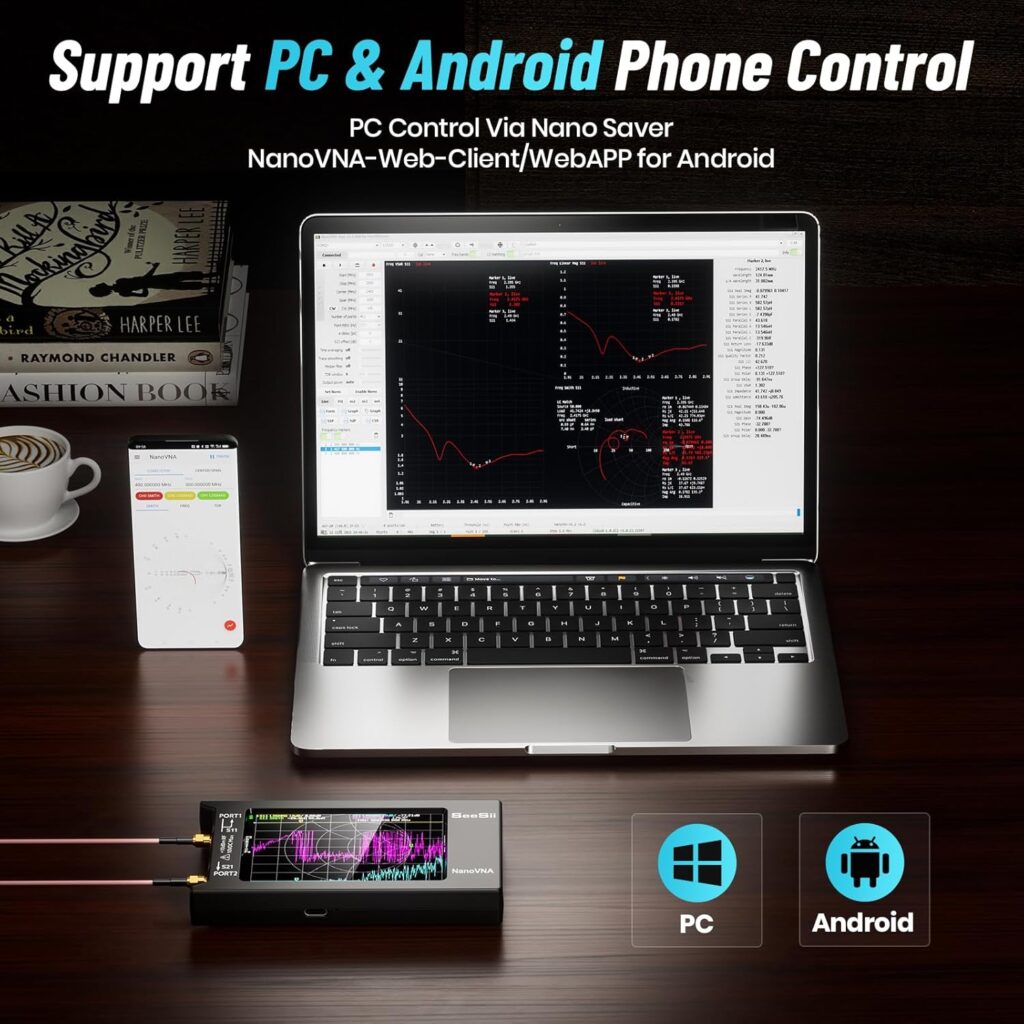
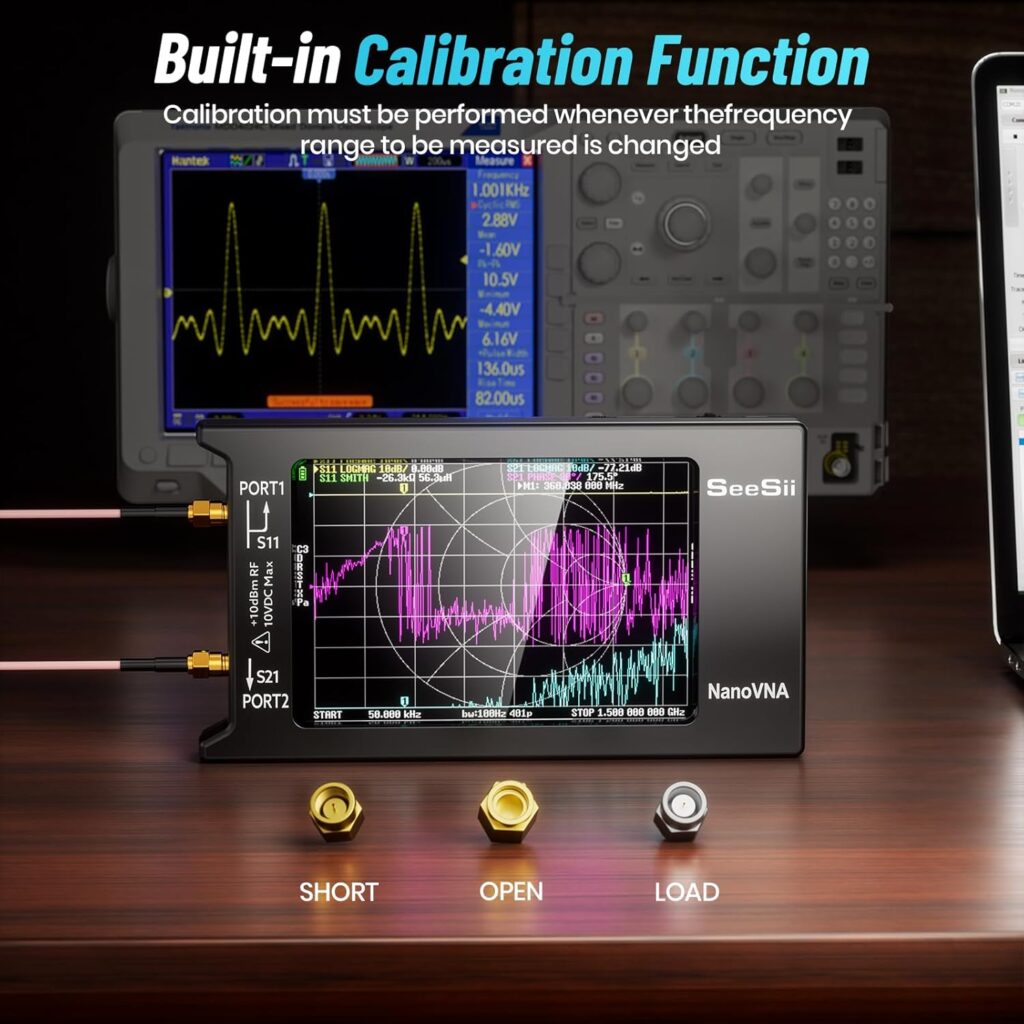
Both use a 4.3-inch IPS LCD display at 800 x 480 resolution with resistive touch input and three side buttons. Both use an aluminium enclosure. Both ship with a 5,000 mAh battery rated for approximately seven hours of continuous use, and both can act as a USB power bank when not in use. Both connect to a PC via USB-C and use a virtual serial port interface compatible with NanoVNA-Saver on Windows, macOS, and Linux.
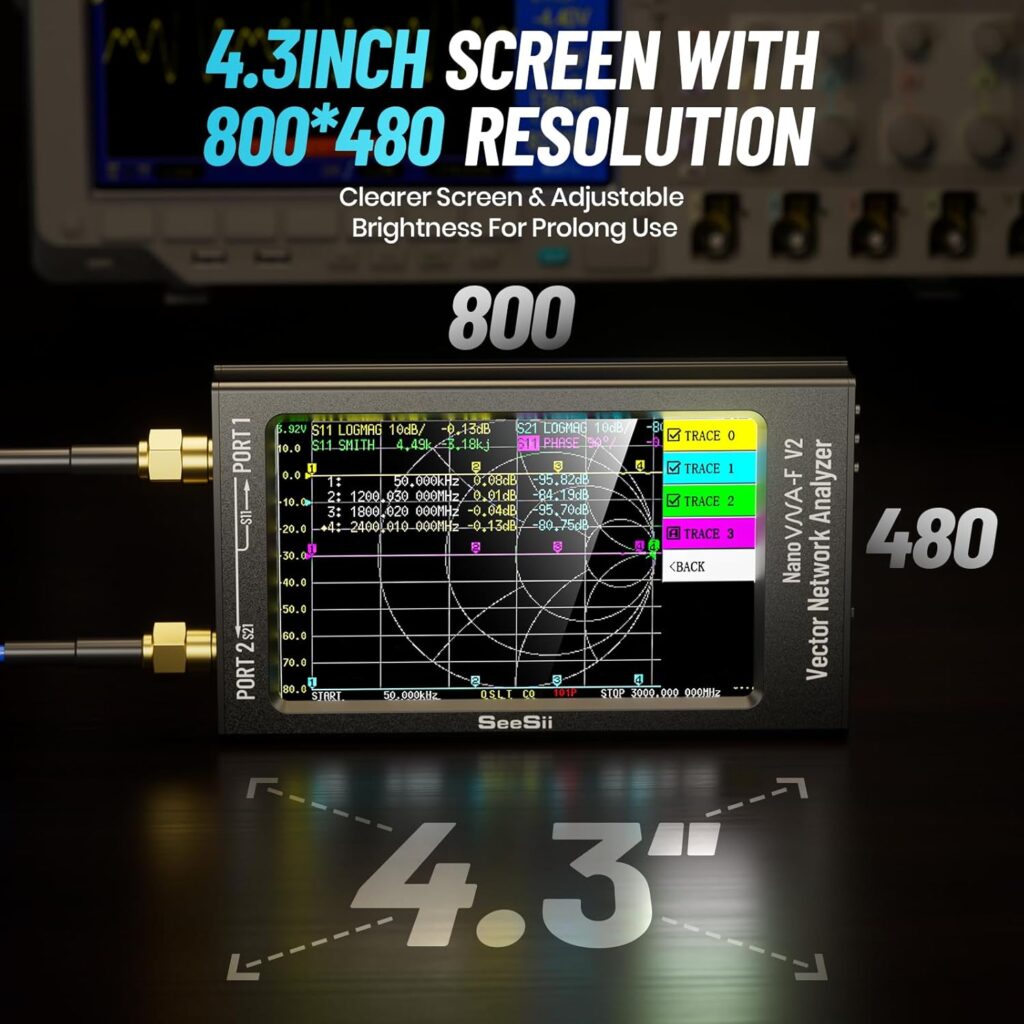
The F V2 is marginally larger at approximately 140 x 75 x 20 mm compared to the H4’s roughly 100 x 70 x 17 mm, though both are genuinely portable. The H4 uses an ABS plastic enclosure, not aluminium — a meaningful difference in RF shielding and durability that favours the F V2, particularly in electromagnetically noisy environments where stray fields can corrupt measurements on an inadequately shielded device.
The F V2 ships with RG405 semi-rigid coax cables rather than the RG174 or RG316 flexible cables typically bundled with H-series devices. RG405 has lower loss and better phase stability, which matters when you are making calibrated measurements at frequencies approaching 3 GHz. The choice of cable bundled with the device is a reasonable indicator of what frequency range the manufacturer actually expects you to use it at.
Firmware and Software Ecosystem
The H4 runs Hugen’s firmware, maintained at github.com/hugen79/NanoVNA-H, with an active community developing alternative builds including DiSlord’s widely used NanoVNA-D fork. The H4’s firmware is not compatible with the H or original NanoVNA — the STM32F303 and 4-inch display required too many changes — but it benefits from the largest NanoVNA user community and the most extensive documentation of any device in this family.
The F V2 runs its own firmware maintained by BH5HNU at github.com/nanovna-f-v2, also FreeRTOS-based. The firmware ecosystem is smaller than the H-series community but actively maintained, and the F V2 firmware is not interchangeable with either H-series or original NanoVNA-F firmware. Calibration data formats differ between the two devices, so if you use both you maintain separate calibration files.
Both devices work with NanoVNA-Saver for multi-segment sweeps, Touchstone export, TDR analysis, and calibration management. Both support 101 scan points natively, with NanoVNA-Saver extending effective resolution through multi-segment sweeps.
Clone Warning
This is worth stating clearly because it affects purchasing decisions significantly for the F V2 in particular.
The ADF4350 and AD8342 are the components that give the F V2 its performance above 1.5 GHz. Both are relatively expensive RF ICs. Clone manufacturers (of which there are many, flooding Amazon and AliExpress) have been documented using salvaged, rejected, or counterfeit versions of these parts to reduce cost. A clone F V2 with substandard ADF4350 or AD8342 may measure acceptably at HF and VHF and fail meaningfully at frequencies above 1 GHz, which is precisely the range where you are paying for the F V2’s capability over the H4.
The official source for the NanoVNA-F V2 is Chelegance (chelegance.com). Buying from an unverified third-party listing on a marketplace platform carries meaningful risk of receiving an instrument that does not meet the specifications it was sold under. The H4 from Hugen is also widely cloned, but the Si5351 and SA612 parts used in the H4 are far less expensive and less frequently substituted, making clone quality more consistent for that device.
The Scan Points Limitation
Both devices are constrained to 101 scan points in their native firmware. For the H4 measuring a narrowband filter at 145 MHz, 101 points across a 10 MHz span gives 100 kHz resolution — usually sufficient. For the F V2 measuring a 5G NR filter at 2.5 GHz across a 500 MHz span, 101 points gives 5 MHz resolution per point, which may be entirely inadequate to capture filter response accurately. NanoVNA-Saver can stitch multi-segment sweeps together to improve effective resolution, but this increases sweep time and requires careful calibration management across segments. If you regularly need high-resolution sweeps in the 1.5–3 GHz range, this limitation is worth understanding before you buy.
Quick Comparison
| NanoVNA-H4 | NanoVNA-F V2 | |
|---|---|---|
| Developer | Hugen | BH5HNU / Chelegance |
| Frequency range | 50 kHz – 1.5 GHz | 50 kHz – 3 GHz |
| Signal source | Si5351 (harmonics above 200 MHz) | ADF4350 PLL (fundamental to 3 GHz) |
| Mixer | SA612 passive | AD8342 active |
| S21 dynamic range | 70/60/40 dB (tiered) | 70/60 dB (tiered) |
| S11 dynamic range | 70/60/40 dB (tiered) | 50/40 dB (tiered) |
| RF output power | 0 dBm | -9 dBm |
| Display | 4.0″ TFT | 4.3″ IPS 800×480 |
| Battery | 1,950 mAh | 5,000 mAh |
| Enclosure | ABS plastic | Aluminium |
| Processor | STM32F303 (M4, 72 MHz) | STM32 (M3 series) |
| Scan points | 101 | 101 |
| Price | ~$50–70 | ~$90–120 |
Which NanoVNA should you buy?
If your measurements stay below 1 GHz, the NanoVNA-H4 is the easiest and cheapest tool to recommend. If you need reliable measurements above 1.5 GHz for Wi-Fi, cellular, or microwave filters, the NanoVNA-F V2 is the instrument designed for that job.
Who Should Buy Which
The NanoVNA-H4 is the right choice for work that stays below 1.5 GHz. HF, VHF, and UHF antenna work, filter characterisation below 1 GHz, feedline analysis, and amateur radio applications across HF through 70 cm all fall comfortably within the H4’s useful operating range. At those frequencies the H4’s 40–70 dB dynamic range is genuinely adequate for most practical measurements, and the lower price, larger firmware community, and more consistent clone quality make it an easier recommendation for general-purpose work.
The NanoVNA-F V2 is the right choice the moment your work regularly takes you above 1.5 GHz. 2.4 GHz Wi-Fi antennas, 2.5 GHz 5G NR filters, cellular bandpass and duplexer characterisation, L-band satellite components, and microwave filter work in the 1–3 GHz range all benefit from the F V2’s fundamental-frequency coverage, higher dynamic range at those frequencies, and better RF output quality from the ADF4350. If you need to characterise a 2.4 GHz antenna, measure a cellular bandpass filter, or verify a duplexer’s isolation above 1.5 GHz, the H4 simply cannot do it and the F V2 can.
The one caveat worth restating is source. Buy the F V2 from Chelegance directly or a verified reseller. The performance difference between a genuine F V2 and a clone with substandard RF ICs is the entire reason you would pay the premium over an H4 in the first place.
Two great NanoVNAs — just built for different RF jobs
Choose the H4 for HF through UHF work. Choose the F V2 when your measurements move into the microwave region above 1.5 GHz.
Get NanoVNA-F V2 Get NanoVNA-H4