If you’ve ever shopped for walkie-talkies, you’ve probably noticed the bold range claims printed across almost every box:
“Up to 25 miles!”
“30-mile range!”
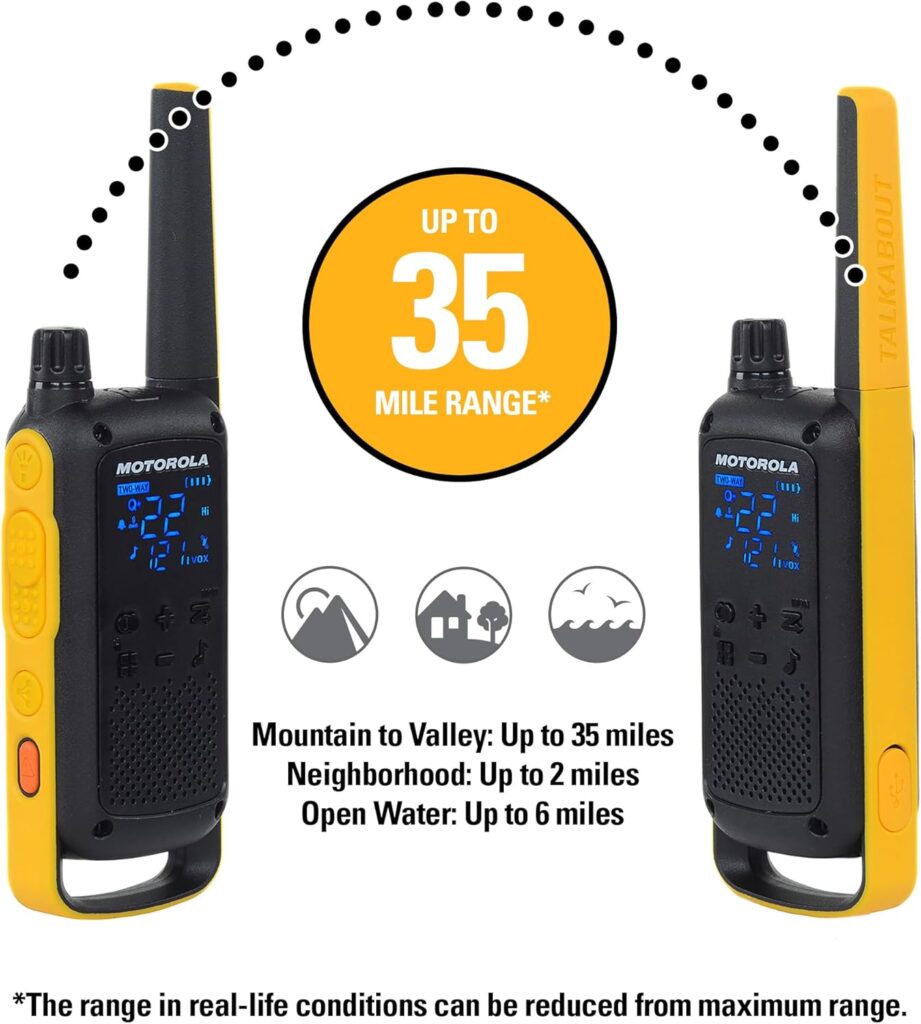
“Over 35 miles!”
These numbers sound impressive — almost too good to be true. And in most real-world cases, they are. While manufacturers aren’t necessarily lying, the test conditions behind these claims are so unrealistic that everyday users rarely get anywhere near the advertised range.
This comprehensive guide breaks down how far FRS radios actually reach, why their performance varies dramatically depending on the environment, what factors matter most, and how you can get the best possible range from your FRS device.
By the end, you’ll understand the true capabilities and limitations of FRS radios, how they compare to GMRS, and whether upgrading your communication system is worth it.
🧭 Understanding the FRS System
The Family Radio Service (FRS) is a personal communication band used in North America. FRS walkie-talkies are popular because:
- They require no license to operate
- They are inexpensive and widely available
- They are simple to use with minimal setup
- They provide clear voice communication for short-range use
FRS operates on UHF frequencies (462–467 MHz) and is regulated by the FCC in the U.S. These requirements limit the maximum allowable power output and require fixed antennas, two major factors that influence range.
Because of these restrictions, FRS radios are inherently short-range devices, ideal for family outings, small events, local communication, and recreational use — but not designed for long-distance communication.
📏 The Truth Behind Advertised Radio Range
Manufacturers commonly claim ranges between 20 and 40 miles. These numbers are technically possible, but only under perfect circumstances.
🌤️ How manufacturers test their range
To achieve maximum range, radios are typically tested in:
- Wide open, flat terrain
- No trees, buildings, vehicles, or people
- No electrical interference
- Clear line-of-sight between antennas
- Elevated transmission points (hilltops, mountaintops, towers)
- Dry, stable atmospheric conditions
These are ideal laboratory-like conditions — and you are unlikely to encounter them in everyday life.
🎯 The real-world takeaway
The actual range you get from your FRS radio may be only 5–10% of the advertised number, depending on where you use it.
📡 Real-World FRS Range in Different Environments
Here’s a realistic breakdown of what you can expect in various scenarios.
🌆 1. Indoor Buildings
Typical range: 0.2 to 1 mile
Using FRS radios indoors significantly reduces range because:
- Walls absorb and scatter UHF signals
- Metal framing blocks RF energy
- Elevators act like Faraday cages
- Electrical equipment generates interference
- Multiple floors cause compound losses
Large buildings like schools, hospitals, hotels, or warehouses may reduce range even further — sometimes below half a mile.
🏘️ 2. Suburban Areas
Typical range: 0.5 to 2 miles
Suburban environments introduce obstacles like:
- Houses
- Trees
- Vehicles
- Fences
- Power lines
- Small hills
These block or weaken UHF signals, reducing range substantially.
🌲 3. Forests and Wooded Terrain
Typical range: 1 to 3 miles
Moist leaves, dense trees, and uneven ground all attenuate radio signals. UHF does better than VHF in penetrating vegetation but still loses strength quickly in forests.
🏞️ 4. Open Rural or Farmland Areas
Typical range: 2 to 5 miles
Flat, open terrain without many obstacles allows FRS signals to travel much farther. Even so, performance depends on antenna height and atmospheric conditions.
🌊 5. Over Water
Typical range: 5 to 10 miles
Water surfaces reflect radio waves and allow them to travel more efficiently. Boating, fishing, and shoreline communication often produce the longest real-world ranges.
🗻 6. Mountain-to-Mountain or Hilltop-to-Hilltop
Typical range: 20 to 35 miles
This is the scenario manufacturers use to justify their maximum claims.
Two operators standing on unobstructed high points may achieve extreme distances because:
- There is perfect line-of-sight
- No obstructions exist between radios
- Air is thin and clean at altitude
- Curvature of the Earth isn’t a limiting factor
These conditions are rare but technically achievable.
📡 Why FRS Radios Have Limited Range
FRS radios aren’t designed for long-distance communication. Several built-in limitations affect performance.
1. Low Power Output
FRS radios are limited to:
- 0.5 watts on some channels
- 2 watts maximum on others
Power directly impacts range. A 2-watt limit means performance will always be limited.
2. Fixed, Non-Removable Antennas
FCC rules require fixed antennas on FRS radios, preventing users from attaching more efficient antennas. Antenna performance is one of the biggest drivers of range.
A short, stubby antenna is convenient — but sacrifices range.
3. UHF Frequency Behavior
UHF signals are great at penetrating buildings but do not travel as far outdoors as lower-frequency VHF signals.
4. Shared Channels and Interference
FRS radios share frequencies with GMRS users, and many families use the same channels. Interference reduces clarity and effective range.
🧭 How to Improve FRS Range Significantly
While you can’t increase power or change antennas, you can optimize usage.
🌤️ 1. Improve Your Antenna Position
Small changes make a big difference:
- Hold the radio upright
- Keep it away from your body
- Avoid covering the antenna with your hand
- Elevate your position if possible
Even gaining 1–2 meters of height improves range dramatically.
🔋 2. Maintain Strong Battery Levels
Low battery reduces transmission power. Always begin with fully charged radios for maximum range.
📡 3. Use Channels with Higher Power
Channels 1–7 and 15–22 allow up to 2 watts, which provides better performance.
🏞️ 4. Reduce Obstructions
Move to:
- Higher ground
- Open areas
- Clear lines of sight
Even small improvements reduce signal absorption.
🧩 5. Reduce Noise and Interference
Avoid using radios near:
- Wi-Fi routers
- Microwave ovens
- Electric motors
- Metal structures
- Dense walls
Finding a cleaner RF environment improves communication clarity.
🔄 How FRS Compares to GMRS
If you find FRS range insufficient, GMRS (General Mobile Radio Service) may be a better option.
⭐ GMRS Advantages
- Up to 5 watts of handheld power
- Mobile units can run 15–50 watts
- Removable antennas for improved performance
- Repeaters can extend range for miles or across entire cities
- Sharper, clearer audio
GMRS easily outperforms FRS in almost every range category.
⚠️ GMRS Downside
You must obtain an FCC license, but it is inexpensive and valid for 10 years.
🎯 So… How Far Do FRS Radios Really Reach?
Here is the honest answer:
Most people will get 0.5 to 2 miles of usable range
in typical neighborhoods, parks, and suburban areas.
In good outdoor conditions, 3 to 5 miles is achievable.
Only in perfect, line-of-sight conditions will you see 20+ miles.
FRS radios are not long-distance communication tools, but they excel as simple, reliable, close-range communication devices for families, events, small teams, and recreational activities.
❓ Frequently Asked Questions (Expanded)
1. Why don’t FRS radios reach the range listed on the box?
Because those tests assume perfect conditions with no obstacles. Real life introduces buildings, trees, terrain, and interference that drastically reduce range.
2. Are expensive FRS radios better than cheap ones?
More expensive models may have slightly better audio and build quality, but range is mostly limited by FCC rules, not price.
3. Can weather affect radio range?
Yes. Moisture, fog, heavy rain, and atmospheric conditions can reduce or improve range slightly.
4. What channel should I use for the best range?
Use high-power channels (1–7 and 15–22). Lower-power channels typically perform worse.
5. Is GMRS worth it for better range?
If you need consistent communication beyond 2 miles, yes — GMRS is significantly more capable.
6. Can FRS radios communicate with GMRS radios?
Yes. They share several overlapping channels. Communication works as long as both radios use matching frequencies and privacy codes.
7. Can trees reduce radio range?
Absolutely. Wet leaves and dense forests greatly weaken UHF radio waves.
8. Do hills and valleys affect FRS range?
Very much. UHF radios require line-of-sight. Being in a valley can cut range to less than half a mile.
9. Can I get better range by standing on something?
Yes. Even elevating the radio by a few feet can significantly increase effective distance.
10. What’s the single biggest factor affecting FRS range?
Obstacles — especially buildings, hills, and dense vegetation.
🏁 Final Thoughts
FRS radios are extremely useful for short-range, reliable communication, but they are often misunderstood because of misleading range claims. Understanding their true real-world performance helps users choose the right tool and avoid disappointment.
For everyday communication within 0.5 to 2 miles, FRS works beautifully.
For anything beyond that — especially professional or outdoor applications — GMRS, business UHF radios, or digital repeater systems are the better choice.